Monday, February 27, 2017

God Post: Baldur

Hail!

I'm writing this ahead of time to be published on the correct day. This is due to lack of internet until Friday. I got this information from Norse Mythology for Smart People.


Baldur (pronounced “BALD-er;” Old Norse Baldr, Old English and Old High German Balder) is one of the Aesir gods. He’s the son of Odin and Frigg, the husband of the obscure goddess Nanna, and the father of the god Forseti.

He’s loved by all the gods, goddesses, and beings of a more physical nature. So handsome, gracious, and cheerful is he that he actually gives off light.[1]

The meaning and etymology of his name are uncertain and have been the topic of intense scholarly debate. Numerous possibilities have been proposed, including a derivation from the Proto-Indo-European root *bhel- (“white”), Old Norse bál, “fire,” or a hypothesized word for “lord” common to various Germanic languages. The most straightforward – and probably correct – explanation, however, is that his name comes from the Old Norse word baldr, “bold.”[2][3] Scholars have been reluctant to accept this explanation due to its implication of a warlike character for Baldur. But as we’ll see below, Baldur may not have been as innocent and passive as he’s portrayed to be in the late Old Norse literary source that provides the most extensive description of the god and the tales in which he features.

This literary source is the Prose Edda of the medieval Icelandic scholar Snorri Sturluson. From this treatise on mythology and poetics comes the most complete account we have of the primary tale concerning Baldur, the story of his death and resurrection. This tale can be briefly summarized as follows:

When Baldur began to have dreams of his death, Frigg went around to everything in the world and secured from each of them an oath to not harm her son. Confident in Baldur’s invincibility, the gods amused themselves by throwing weapons and any random thing they could find at Baldur and watching them bounce off of him, leaving him utterly unscathed.

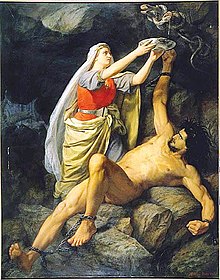
Loki, the guileful trickster of the gods, sensed an opportunity for mischief. He inquired of Frigg whether she had overlooked anything whatsoever in her quest to obtain oaths. She casually answered that she had thought the mistletoe to be too small and harmless a thing to bother asking for such a promise. Loki straightaway made a spear from the mistletoe and convinced the blind god Hodr to throw it at Baldur. The projectile pierced the god, and he fell down dead.

The anguished gods then ordained that one of them should go to the underworld to see if there was any way Baldur could be retrieved from the clutches of the death goddess, Hel. Hermod, another one of Odin’s many sons, agreed to make this journey, and, mounting Odin’s steed, Sleipnir, he rode down the world-tree until he came to its dark and damp roots, wherein lies Hel’s abode. When he arrived, he found his brother, pale and grim, sitting in the seat of honor next to Hel. Hermod implored the dreadful goddess to release Baldur, and after much persuasion, she replied that she would give him up if and only if everything in the world would weep for Baldur – to prove, in other words, that he was as universally beloved as Hermod claimed.

The whole world did indeed weep for the generous son of Odin – all, that is, save one creature. The giantess Þökk (“Thanks”), generally assumed to be Loki in disguise, callously refused to perform the act that would secure Baldur’s return.[4]

And so the bright god lay in the grave until Ragnarok, the destruction of the cosmos at the end of the great mythical cycle, after which Baldur returned at last to the land of the living, gladdening the hearts of the creatures who filled the new world.[5]

While this account comes overwhelmingly from one source, bits and pieces of it can be found in earlier Old Norse poetry, and many details of the narrative are depicted on pieces of jewelery dating from before the Viking Age.[6] We can be reasonably certain that the tale as told by Snorri is not only authentic, at least in its general outline, but very, very old.

However, whether out of ignorance or a desire to portray Baldur as a martyr-like figure, Snorri likely omitted a key element of Baldur’s character: a warlike disposition. There’s one other literary account of Baldur’s death, that told by the medieval Danish historian Saxo Grammaticus. As confused and euhemerized (historicized) as this version is, one of the characteristics that stands out is Baldur’s constant eagerness to engage in battle. He’s even depicted as something of a warlord. This, combined with the many kennings that link Baldur’s name with weapons and war in general, suggests that Baldur was much more of an active fighter and less of a passive, innocent sufferer than Snorri makes him out to be.[7]

Other than that, references to Baldur are scarce. He’s mentioned in an Anglo-Saxon chronicle (where he’s given the additional name Bældæg, “The Shining Day,” and described as a son of Woden, the Old English name for Odin).[8] Another brief reference to him can be found in the so-called Second Merseburg Charm from continental Germany, which comes from a manuscript that dates from the ninth or tenth century CE.

While we know relatively little about Baldur due to the fragmentary nature of the sources of our knowledge of pre-Christian Germanic religion, he evidently occupied a position of renown and splendor in the hearts and minds of the heathen Germanic peoples. He seems to have been regarded as the divine animating force behind the beauty of life at the peak of its strength and exuberance. His death marks the beginning of the decline into old age, night, winter, and ultimately the death and rebirth that characterize Ragnarok.

Looking for more great information on Norse mythology and religion? While this site provides the ultimate online introduction to the topic, my book The Viking Spirit provides the ultimate introduction to Norse mythology and religion period. I’ve also written a popular list of The 10 Best Norse Mythology Books, which you’ll probably find helpful in your pursuit.

Learning Asatru: Eleven Months

Hail!

Today marks eleven months that I've been learning Astaru. It's been a pretty great month, with only a small amount of problems. However, I've enjoyed myself and I can't believe that I'm at this point. I'm really excited and amazed that I've lasted this long. Well now I move onto the last four weeks of this first year and then I will be done.

Monday, February 20, 2017

God Post: Hella

Hail!

This post will be the last one that I don't write early and have scheduled to be posted at a certain time. So today I'm talking about the Norse goddess Hella, one of Loki's three children. Here's some info from the site Norse Mythology for Smart People.

 Hel - Norse Mythology for Smart People


Hel (Old Norse Hel, “Hidden”[1]) is a giantess and/or goddess who rules over the identically-named Hel, the underworld where many of the dead dwell. Her name’s meaning of “Hidden” surely has to do with the underworld and the dead being “hidden” or buried beneath the ground.
According to the thirteenth-century Icelandic scholar Snorri Sturluson, Hel is the daughter of Loki and the giantess Angrboda (Old Norse Angrboða, “Anguish-boding”), and therefore the sister of the wolf Fenrir and the world serpent, Jormungand.[2] This makes her part of a highly dangerous and disreputable family.

Hel is generally presented as being rather greedy, harsh, and cruel, or at least indifferent to the concerns of both the living and the dead. However, her personality is little-developed in what survives of Old Norse literature. She’s mostly mentioned only in passing. Snorri describes her appearance as being half-black, half-white, and with a perpetually grim and fierce expression on her face.[3]

The only surviving myth in which she features prominently is that of The Death of Baldur. The beloved god Baldur was slain by none other than Hel’s father, Loki, and the gods sent an emissary named Hermod to Hel in hopes of retrieving Baldur. Hermod pleaded with Hel, telling her how every living thing was in sorrow over the loss of Baldur. But Hel wouldn’t give up her prize so easily. She told Hermod – in a taunting way, we can imagine – that she would only consent to release Baldur if every last thing in the universe wept for him. Hermod and the other gods went around and got almost everything in the cosmos to weep for Baldur. Only one giantess, who was probably Loki in disguise, refused. But because of that one refusal, the terms of Hel’s offer weren’t met, and Hel kept Baldur in her cold clutches.

Because of how sparsely-defined her character is, many scholars view Hel as more of a late literary personification of the grave than a goddess who was actually worshiped or appeased in her own right.[4] Due to the lack of conclusive evidence either way, this must remain an open question.

Looking for more great information on Norse mythology and religion? While this site provides the ultimate online introduction to the topic, my book The Viking Spirit provides the ultimate introduction to Norse mythology and religion period. I’ve also written a popular list of The 10 Best Norse Mythology Books, which you’ll probably find helpful in your pursuit.

Saturday, February 18, 2017

Moron in the News

Hail!

I heard about this on Monday, so I'm sorry that I didn't post it then, but I wanted to talk about something that really makes me want to shake my head. It seems that an unoffical member of AFA is upset about our declaration against racism, homophobia, and other things that we just don't need in the community. Here's the link.

http://www.heathenhof.com/arizona-man-files-suit-against-the-asatru-community-heathen-talk-network-and-the-troth/

Now this really makes me wonder about the state of the community, or I should say people that follow a religion like Asatru, or Heathenism, that hates a different opinion. People like him are the reason that I don't call myself a heathen. If he wants to waste his money on something has stupid as this, which shows the state of how people feel when others exercise their constitutional rights, then I really worry about the future of this community.

If he manages to shut down Heathen Talk Network, which I do something not agree with, then what's next? If he manages to have The Troth shut down or even the group that I'm apart of, TAC, then what's next? It seems that he only wants one kind of heathenism noticed, the kind that makes us, as a whole, look bad. The kind that makes people think that we hate other people. I might not agree with most people but I do agree with their right to either have an opinion or be a certain way.

I don't support someone shutting down another person's opinion or using the courts to get that opinion stifled. I pray to Odin that the judge will have the wisdom to shut this case down and throw it out and I pray to Thor that those that are being targeted will have the strength to stand up against this. Personally I can't wait to hear that it's been thrown out. Of course I'm worried that if that happens that he'll personally target the homes of heathens that he lost to.

And that will make heathenism look even worse.

Thursday, February 16, 2017

Blog of an Independent Asatruer Up Three Months

Hail!

Today marks three months that my blog has been up. I'm really excited that my blog has made it this far and I'm glad that it's being read and enjoyed. I hope to continue with this blog long after my first year in Asatru is over. Thanks, everyone, for coming on here and reading.

Tuesday, February 14, 2017

Heathen Holiday: Feast of Vali

Hail!

So it's time for another Heathen holiday. Here's one, the Feast of Vali. I won't be celebrating due to lack of offerings that I wanted to give.

This feast originally celebrated the death of Hothr at the hands of Vali. This late winter festival relates to the triumphant return of the light of the sun over the dark days of winter. Today it is traditional celebration of the family. A time for the customary exchange of cards and gifts with loved ones. It is also a time for the renewal of marriage vows and an occasion for marriages.

Monday, February 13, 2017

God Post: Sif

Hail!

I'm finally getting back on-track with these posts. Today we talk about the goddess Sif, wife of Thor. In the myths her hair is cut by Loki, though most believe that this is talking about the grain being brought in. Loki had to get hair made for her to replace what he cut. The return of her hair is seen as the harvest coming.

Thursday, February 9, 2017

Late Post: God Post: Sigyn

Hail!

So this is a late post because time just went by. So this one is Signy, the wife of Loki. There's not much to talk about her, though she's mentioned in the Eddas. She is the faithful wife of Loki and holds a basin over Loki's head to catch the venom. When she pulls away Loki screams when the venom hits him causing earthquakes.

Thursday, February 2, 2017

Heathen Holidays: Charming of the Plow and Feast of Barri

Hail!

Today is two Heathen holidays. Charming of the Plow and Feast of Barri. Paxton puts Charming the Plow on the second, which enables Heathens to celebrate it at the same time that Wiccans honor Imbolc. It's about the land and healing it. So here's some info.

Charming of the Plow. Offerings are made to Earth Mother and the first furrow is cut.

Feast of Barri, celebrating the marriage of Freyr and Gerd. Plant seeds indoors for later transplanting.


I hope that you enjoy them both.