Tonight is the final night of Yule. It's to wisdom and sacred all
Divine Friends. It's also the Oath Night, meaning that you renew your
oaths to the gods, ancestors, and other beings. It's also the end of
2016, which I'm happy about. This year was nuts and I'm glad that it's
over. Pour a drink to all the divine friends and renew your oaths. I'm
planning on doing that tonight, making an oath to continue to learn more
about Heathenism.
I hope that you all have a good night, New Years Eve night, and future.
Saturday, December 31, 2016

Friday, December 30, 2016
Eleventh Night of Yule
Tonight is the eleventh night of Yule and we remember self-reliance. Being self-reliant, means that your on your own and not using others resources to survive. The only exemption to this is when you're taking care of your parents because they can't take care of themselves. Tonight is also the night that's sacred to the Valkyries and Warriors. Pour a drink to them and remember the virtue of self-reliance.
Thursday, December 29, 2016
New Moon and the Tenth Night of Yule
Tonight is the tenth day of Yule and it deals with Justice. We honor
Sunna and the light, which is going to get stronger as we get closer to middle part of winter. Justice is something that has changed over time but the belief
in it has never changed. Tonight is also the New Moon, time to honor the
Norse goddess Hel. I hope that you have a good one.
Wednesday, December 28, 2016
Ninth Night of Yule
Tonight is the ninth day of Yule. We honor Odin and the fathers, like we honored Frigga and the Desir. Tonight we focus on honor. Honor is the most important thing that we have and it must not be given to someone unless we know that they are good people and are honorable. Honor also means honoring your parents. They brought you into this world. However, media has made it clear that honoring your parents is something that belongs in the past.
Makes me wonder how we will still survive.
Makes me wonder how we will still survive.
Tuesday, December 27, 2016
Learning Asatru (9 Months)
Hail!
Today marks nine months that I've been learning about Asatru and practicing it. So excited about being at this point and I just love the religion that I'm apart of. Of course it's changed slightly but I'm still honoring the Norse gods and still honoring my ancestors. Just three more months and I'll hit a year, which I'm so excited about.
Today marks nine months that I've been learning about Asatru and practicing it. So excited about being at this point and I just love the religion that I'm apart of. Of course it's changed slightly but I'm still honoring the Norse gods and still honoring my ancestors. Just three more months and I'll hit a year, which I'm so excited about.
Eight Night of Yule
When the sun goes down it will be the Eighth night of Yule. Tonight we
deal with Truth and we honor Skadi and Ullr. Being truthful means not
telling lies. It also means not getting yourself into situations where
you do lie. The truth is a concept that most everyone values and
something that they expect others to value.
Monday, December 26, 2016
Seventh Night of Yule
When the sun goes down it will be the seventh night of Yule. It's sacred to Thor and his children. We learn about Fidelity, which means being faithful to your spouse, to your friends, and to yourself. The gathering darkness is over us and we must remember that sometimes we do need help. That's why you have friends that you can count on when your in a bind. When you don't practice it then it hurts the person that is affected.
We see this all the time when husband's cheat on their wives or the wives cheat on their husbands. We see it when women have relations with women while married to their husbands and the same thing with the husbands. The bounds that you've spoken should be important, far more important than some fling that you've decided to have. It's a virtue that is needed in today's world and that's why people will still look up to those that have remained together for over fifty years.
We see this all the time when husband's cheat on their wives or the wives cheat on their husbands. We see it when women have relations with women while married to their husbands and the same thing with the husbands. The bounds that you've spoken should be important, far more important than some fling that you've decided to have. It's a virtue that is needed in today's world and that's why people will still look up to those that have remained together for over fifty years.
Gods Post: Heimdall
Hail!
So I've left the giants and are now going to the gods. Heimdall is the first god that I will be covering. Heimdall is believed to be the son of Odin but also of the nine waves, or nine mothers. Heimdall can see further than any god, does not need sleep, guards Asgard, and will blow the horn to signal the end of the world. Before he became the guardian of the Bitfrost bridge, he traveled Midgard, and maybe other places, and fathered many children. So we're considered his sons and daughters.

He and Loki will kill each other during the final battle.
So I've left the giants and are now going to the gods. Heimdall is the first god that I will be covering. Heimdall is believed to be the son of Odin but also of the nine waves, or nine mothers. Heimdall can see further than any god, does not need sleep, guards Asgard, and will blow the horn to signal the end of the world. Before he became the guardian of the Bitfrost bridge, he traveled Midgard, and maybe other places, and fathered many children. So we're considered his sons and daughters.
He and Loki will kill each other during the final battle.
Sunday, December 25, 2016
Sixth Night of Yule
Tonight is the sixth night of Yule and the half-way point in the twelve days of celebration. Tonight is dedicated to Eir and to healing. Today we focus on discipline. It takes time and energy to master a certain kind of discipline. If we have discipline in our lives then things move faster and easier. Learning healing is a discipline and a good one. I hope that you all have a wonderful Yule.
Saturday, December 24, 2016
Fifth Night of Yule
Tonight is the fifth night of Yule. It's sacred to the community and covers hospitality. Part of being a Heathen, no matter what kind of Heathenism that you practice, is being a good guest. If you can't be a good guest then there's something wrong with you. When someone comes to your home offer them food and drink. If they turn it down then your not at fault in the eyes of the gods. Community is important, no matter what kind of community that it is.
Do things for the community and enjoy the fruits of your labors.
Do things for the community and enjoy the fruits of your labors.
Friday, December 23, 2016
Fourth Night of Yule
Tonight is the fourth night of Yule. It’s dedicated to Frey, Njord, and Aegir. The quality that we remember on this night is love. Loving others, loving yourself, and helping them out when they need it. Love is the most powerful force in the universe and we honor these three gods on this night. I hope that you have a wonderful night.
The Giants- Y
Hail!
This is the final one for the long series of giants. I get my info from Wikipedia, which isn't the best site but they did well.
Y
Ymir
In Norse mythology, Ymir, Aurgelmir, Brimir, or Bláinn is the ancestor of all jötnar. Ymir is attested in the Poetic Edda, compiled in the 13th century from earlier traditional material, in the Prose Edda, written by Snorri Sturluson in the 13th century, and in the poetry of skalds. Taken together, several stanzas from four poems collected in the Poetic Edda refer to Ymir as a primeval being who was born from venom that dripped from the icy rivers Élivágar and lived in the grassless void of Ginnungagap. Ymir birthed a male and female from the pits of his arms, and his legs together begat a six-headed being. The gods Odin, Vili and Vé fashioned the Earth (elsewhere personified as a goddess; Jörð) from his flesh, from his blood the ocean, from his bones the hills, from his hair the trees, from his brains the clouds, from his skull the heavens, and from his eyebrows the middle realm in which mankind lives, Midgard. In addition, one stanza relates that the dwarfs were given life by the gods from Ymir's flesh and blood (or the Earth and sea).
In the Prose Edda, a narrative is provided that draws from, adds to, and differs from the accounts in the Poetic Edda. According to the Prose Edda, after Ymir was formed from the elemental drops, so too was Auðumbla, a primeval cow, whose milk Ymir fed from. The Prose Edda also states that three gods killed Ymir; the brothers Odin, Vili and Vé, and details that, upon Ymir's death, his blood caused an immense flood. Scholars have debated as to what extent Snorri's account of Ymir is an attempt to synthesize a coherent narrative for the purpose of the Prose Edda and to what extent Snorri drew from traditional material outside of the corpus that he cites. By way of historical linguistics and comparative mythology, scholars have linked Ymir to Tuisto, the Proto-Germanic being attested by Tacitus in his 1st century AD work Germania and have identified Ymir as an echo of a primordial being reconstructed in Proto-Indo-European mythology.
This is the final one for the long series of giants. I get my info from Wikipedia, which isn't the best site but they did well.
Y
Ymir
In Norse mythology, Ymir, Aurgelmir, Brimir, or Bláinn is the ancestor of all jötnar. Ymir is attested in the Poetic Edda, compiled in the 13th century from earlier traditional material, in the Prose Edda, written by Snorri Sturluson in the 13th century, and in the poetry of skalds. Taken together, several stanzas from four poems collected in the Poetic Edda refer to Ymir as a primeval being who was born from venom that dripped from the icy rivers Élivágar and lived in the grassless void of Ginnungagap. Ymir birthed a male and female from the pits of his arms, and his legs together begat a six-headed being. The gods Odin, Vili and Vé fashioned the Earth (elsewhere personified as a goddess; Jörð) from his flesh, from his blood the ocean, from his bones the hills, from his hair the trees, from his brains the clouds, from his skull the heavens, and from his eyebrows the middle realm in which mankind lives, Midgard. In addition, one stanza relates that the dwarfs were given life by the gods from Ymir's flesh and blood (or the Earth and sea).
In the Prose Edda, a narrative is provided that draws from, adds to, and differs from the accounts in the Poetic Edda. According to the Prose Edda, after Ymir was formed from the elemental drops, so too was Auðumbla, a primeval cow, whose milk Ymir fed from. The Prose Edda also states that three gods killed Ymir; the brothers Odin, Vili and Vé, and details that, upon Ymir's death, his blood caused an immense flood. Scholars have debated as to what extent Snorri's account of Ymir is an attempt to synthesize a coherent narrative for the purpose of the Prose Edda and to what extent Snorri drew from traditional material outside of the corpus that he cites. By way of historical linguistics and comparative mythology, scholars have linked Ymir to Tuisto, the Proto-Germanic being attested by Tacitus in his 1st century AD work Germania and have identified Ymir as an echo of a primordial being reconstructed in Proto-Indo-European mythology.
Thursday, December 22, 2016
Third Night of Yule
Tonight is the third night of Yule. It’s sacred to Mani and the
darkness. During this night we talk about courage. Courage is doing
something even though it might be dangerous for you or others. Courage
is something that is lacking in this world and this night reminds us to
keep that virtue in our hearts. Mani rules tonight and the darkness is
all around us. I believe that courage, including coming out as gay or
pagan, is important.
Just as important as those that fight for our rights.
Just as important as those that fight for our rights.
The Giants- V
Hail!
It's time to move to the letter V. I get my info from Wikipedia.
V
Vafthrúdnir
Vafþrúðnir (Old Norse "mighty weaver"[1]) is a wise jötunn in Norse mythology. His name comes from Vaf, which means weave or entangle, and thrudnir, which means strong or mighty. Some interpret it to mean “mighty in riddles”.[2] It may be anglicized Vafthruthnir or Vafthrudnir. In the Poetic Edda poem Vafþrúðnismál, Vafþrúðnir acts as (the disguised) Odin's host and opponent in a deadly battle of wits that results in Vafþrúðnir's defeat.
Vali
In Norse mythology, Váli was one of the unlucky sons of Loki. He is mentioned in the Gylfaginning section of Snorri Sturluson's Prose Edda, chapter 50. After the death of Baldr, the Æsir chase down and capture Loki.
Vanargand
Another name for Fenrir
Vasad
Vosud or Vasad a Jotnar from Norse mythology ("Wet and Sleety") was the father of Vindsval and grandfather of winter.
Vidblindi
Víðblindi or Viðblindi ("Very blind") is a giant in Norse mythology.
The skald Hallar-Steinn uses the kenning "Viðblindi's boar" (Viðblinda göltr) for whale in a stanza quoted by Snorri Sturluson in his Skáldskaparmál. Snorri explains it as follows:
Rudolf Simek noted that the only giant known for fishing whales is Hymir,[2] but he is never called Víðblindi / Viðblindi.[3]
Víðblindi is also listed among the giants in the þulur.
Vörnir
Vörnir is a giant from Norse mythology. He is only extant in Nafnaþulur in the Prose Edda.
The name has been connected to the PIE root *ver- (from *verunyos?), meaning "to cover". Cognates in other Indo-European languages have been suggested, but remain uncertain. The Vedic Varuna, the Mitanni names aruna and urvana, Uranos, the sky god in Greek mythology, the Slavic god Veles, and velnias, the Lithuanian for "devil"
It's time to move to the letter V. I get my info from Wikipedia.
V
Vafthrúdnir
Vafþrúðnir (Old Norse "mighty weaver"[1]) is a wise jötunn in Norse mythology. His name comes from Vaf, which means weave or entangle, and thrudnir, which means strong or mighty. Some interpret it to mean “mighty in riddles”.[2] It may be anglicized Vafthruthnir or Vafthrudnir. In the Poetic Edda poem Vafþrúðnismál, Vafþrúðnir acts as (the disguised) Odin's host and opponent in a deadly battle of wits that results in Vafþrúðnir's defeat.
Vali
In Norse mythology, Váli was one of the unlucky sons of Loki. He is mentioned in the Gylfaginning section of Snorri Sturluson's Prose Edda, chapter 50. After the death of Baldr, the Æsir chase down and capture Loki.
Vanargand
Another name for Fenrir
Vasad
Vosud or Vasad a Jotnar from Norse mythology ("Wet and Sleety") was the father of Vindsval and grandfather of winter.
Vidblindi
Víðblindi or Viðblindi ("Very blind") is a giant in Norse mythology.
The skald Hallar-Steinn uses the kenning "Viðblindi's boar" (Viðblinda göltr) for whale in a stanza quoted by Snorri Sturluson in his Skáldskaparmál. Snorri explains it as follows:
- Here the whale is called Boar of Viðblindi; this Viðblindi was a giant who drew whales out of the sea like fishes.
-
- —Skáldskaparmál (XLVI), Brodeur's translation
Rudolf Simek noted that the only giant known for fishing whales is Hymir,[2] but he is never called Víðblindi / Viðblindi.[3]
Víðblindi is also listed among the giants in the þulur.
Vörnir
Vörnir is a giant from Norse mythology. He is only extant in Nafnaþulur in the Prose Edda.
The name has been connected to the PIE root *ver- (from *verunyos?), meaning "to cover". Cognates in other Indo-European languages have been suggested, but remain uncertain. The Vedic Varuna, the Mitanni names aruna and urvana, Uranos, the sky god in Greek mythology, the Slavic god Veles, and velnias, the Lithuanian for "devil"
Wednesday, December 21, 2016
Second Night of Yule (High Feast of Yule)
Tonight is the second night of Yule and the actual Wiccan Sabbath. This night is sacred to Odin and the Ancestors. It covers Perseverance. The Wild Hunt is at it’s height, it started at Samhain, and continues through this night. We stay inside during this night as Odin and his riders are riding the night. We remind ourselves about the importance of Perseverance, which is seeing something through no matter how hard things get. If we give up then what was the point of starting?
Have a good Yule and stay warm.
Have a good Yule and stay warm.
The Giants- U
Hail!
Time to move onto the letter U. I get my info from Wikipedia, which isn't the best site but they did a good job here.
U
Ulfrun
One of the nine mothers of Heimdall.
Unn
One of the nine daughters of Aegir.
Utgarda-Loki
In Norse mythology, Útgarða-Loki (Anglicized as Utgarda-Loki and Utgard-Loki) was the ruler of the castle Útgarðr in Jötunheimr. He was one of the Jötnar and his name means literally "Loki of the Outyards," to distinguish him from Loki, the companion of Thor.
Time to move onto the letter U. I get my info from Wikipedia, which isn't the best site but they did a good job here.
U
Ulfrun
One of the nine mothers of Heimdall.
Unn
One of the nine daughters of Aegir.
Utgarda-Loki
In Norse mythology, Útgarða-Loki (Anglicized as Utgarda-Loki and Utgard-Loki) was the ruler of the castle Útgarðr in Jötunheimr. He was one of the Jötnar and his name means literally "Loki of the Outyards," to distinguish him from Loki, the companion of Thor.
Tuesday, December 20, 2016
Heathen Holiday: Mother's Night
Even though I practice Norse Wicca I do plan to honor the twelve nights of Yule. So tonight is Mother’s Night, the first night of Yule. It’s sacred to Frigga, Freya, and the Disir and covers Industriousness. Here’s some info about this night.
As the night before the Winter Solstice, this is the time when the New Year is born. We honor the beginning of Sunnas return and the breaking of Winter?s spell. This is a time to honor Thor and Freyr, celebrate by Blot, Sumbel, and High Feast. Burn a Yule Log and jump the flames for luck and purification.
As the night before the Winter Solstice, this is the time when the New Year is born. We honor the beginning of Sunnas return and the breaking of Winter?s spell. This is a time to honor Thor and Freyr, celebrate by Blot, Sumbel, and High Feast. Burn a Yule Log and jump the flames for luck and purification.
The Giants- T
Hail!
Time to move onto the letter T. I get my info from Wikipedia, not the best site but they did a good job here.
T
Thjazi
In Norse mythology, Þjazi (anglicized as Thiazi, Thjazi, Tjasse or Thiassi) was a giant. He was a son of the giant Ölvaldi, brother of giants Iði and Gangr, and the father of Skaði. His most notable misdeed was the kidnapping of the goddess Iðunn, which is related in both the Prose Edda and the skaldic poem Haustlöng.
Thrivaldi
In Norse mythology, Þrívaldi (anglicized as Thrívaldi or Thrivaldi), whose name means "thrice mighty", is a giant killed by Thor.
This fact is mentioned by Snorri Sturluson in the Skáldskaparmál (4), according to which "killer of Þrívaldi" ("vegandi Þrívalda") is a kenning for Thor. Snorri quotes one stanza by Bragi Boddason, who calls Thor "cleaver apart of Þrívaldi's nine heads"[1] ("sundrkljúfr níu höfða Þrívalda"), and another stanza by Vetrliði Sumarliðason who praises Thor for having battered ("lemja") Þrívaldi.
Þrívaldi is also listed in the þulur.
Thrúdgelmir
In Norse mythology, Þrúðgelmir (IPA: [ˈθruːð.ɟɛlmɪr]; Old Norse "Strength Yeller") is a frost giant, the son of the primordial giant Aurgelmir (who Snorri Sturluson in Gylfaginning identifies with Ymir), and the father of Bergelmir. Þrúðgelmir had one brother and one sister, who were elder than he was. Þrúðgelmir's name is sometimes anglicized as Thrudgelmir.
Thrym
In Norse mythology, Þrymr (Thrymr, Thrym; "uproar") was king of the jǫtnar. In one legend, he stole Mjǫlnir, Thor's hammer, to extort the gods into giving him Freyja as his wife. His kingdom was called Jötunheimr, but according to Hversu Noregr byggðist, it was the Swedish province Värmland, then a part of Norway.
Þrymr was foiled in his scheme by the gracefulness of Heimdallr, the cunning of Loki, and the sheer violence of Thor, who later killed Þrymr, his sister, and all of the jotnar kin that had been present at the wedding reception. The poem Þrymskviða gives the details of how Thor got his hammer back. Bergfinnr is a son of Þrymr.
Time to move onto the letter T. I get my info from Wikipedia, not the best site but they did a good job here.
T
Thjazi
In Norse mythology, Þjazi (anglicized as Thiazi, Thjazi, Tjasse or Thiassi) was a giant. He was a son of the giant Ölvaldi, brother of giants Iði and Gangr, and the father of Skaði. His most notable misdeed was the kidnapping of the goddess Iðunn, which is related in both the Prose Edda and the skaldic poem Haustlöng.
Thrivaldi
In Norse mythology, Þrívaldi (anglicized as Thrívaldi or Thrivaldi), whose name means "thrice mighty", is a giant killed by Thor.
This fact is mentioned by Snorri Sturluson in the Skáldskaparmál (4), according to which "killer of Þrívaldi" ("vegandi Þrívalda") is a kenning for Thor. Snorri quotes one stanza by Bragi Boddason, who calls Thor "cleaver apart of Þrívaldi's nine heads"[1] ("sundrkljúfr níu höfða Þrívalda"), and another stanza by Vetrliði Sumarliðason who praises Thor for having battered ("lemja") Þrívaldi.
Þrívaldi is also listed in the þulur.
Thrúdgelmir
In Norse mythology, Þrúðgelmir (IPA: [ˈθruːð.ɟɛlmɪr]; Old Norse "Strength Yeller") is a frost giant, the son of the primordial giant Aurgelmir (who Snorri Sturluson in Gylfaginning identifies with Ymir), and the father of Bergelmir. Þrúðgelmir had one brother and one sister, who were elder than he was. Þrúðgelmir's name is sometimes anglicized as Thrudgelmir.
Thrym
In Norse mythology, Þrymr (Thrymr, Thrym; "uproar") was king of the jǫtnar. In one legend, he stole Mjǫlnir, Thor's hammer, to extort the gods into giving him Freyja as his wife. His kingdom was called Jötunheimr, but according to Hversu Noregr byggðist, it was the Swedish province Värmland, then a part of Norway.
Þrymr was foiled in his scheme by the gracefulness of Heimdallr, the cunning of Loki, and the sheer violence of Thor, who later killed Þrymr, his sister, and all of the jotnar kin that had been present at the wedding reception. The poem Þrymskviða gives the details of how Thor got his hammer back. Bergfinnr is a son of Þrymr.
Monday, December 19, 2016
The Giants- S
Hail!
Moving onto S. I get my info from Wikipedia. Not the best source but they did a good job here.
S
Sigyn
In Norse mythology, Sigyn (Old Norse "victorious girl-friend"[1]) is a goddess and is the wife of Loki. Sigyn is attested in the Poetic Edda, compiled in the 13th century from earlier traditional sources, and the Prose Edda, written in the 13th century by Snorri Sturluson. In the Poetic Edda, little information is provided about Sigyn other than her role in assisting Loki during his captivity. In the Prose Edda, her role in helping her husband through his time spent in bondage is stated again, she appears in various kennings, and her status as a goddess is mentioned twice. Sigyn may appear on the Gosforth Cross and has been the subject of an amount of theory and cultural references.
Skadi
In Norse mythology, Skaði (sometimes anglicized as Skadi, Skade, or Skathi) is a jötunn and goddess associated with bowhunting, skiing, winter, and mountains. Skaði is attested in the Poetic Edda, compiled in the 13th century from earlier traditional sources; the Prose Edda and in Heimskringla, written in the 13th century by Snorri Sturluson, and in the works of skalds.
In all sources, Skaði is the daughter of the deceased Þjazi, and Skaði married the god Njörðr as part of the compensation provided by the gods for killing her father Þjazi. In Heimskringla, Skaði is described as having split up with Njörðr and as later having married the god Odin, and that the two produced many children together. In both the Poetic Edda and the Prose Edda, Skaði is responsible for placing the serpent that drips venom onto the bound Loki. Skaði is alternately referred to as Öndurguð (Old Norse "ski god") and Öndurdís (Old Norse "ski dís", often translated as "lady").
The etymology of the name Skaði is uncertain, but may be connected with the original form of Scandinavia. Some place names in Scandinavia, particularly in Sweden, refer to Skaði. Scholars have theorized a potential connection between Skaði and the god Ullr (who is also associated with skiing and appears most frequently in place names in Sweden), a particular relationship with the jötunn Loki, and that Scandinavia may be related to the name Skaði (potentially meaning "Skaði's island") or the name may be connected to an Old Norse noun meaning "harm". Skaði has inspired various works of art.
Skalli
In Norse mythology, Sköll (Old Norse "Treachery")[1] is a warg that chases the horses Árvakr and Alsviðr, that drag the chariot which contains the sun (Sól) through the sky every day, trying to eat her. Sköll has a brother, Hati, who chases Máni, the moon. At Ragnarök, both Sköll and Hati will succeed in their quests.
Sköll, in certain circumstances, is used as a heiti to refer indirectly to the father (Fenrir) and not the son. This ambiguity works in the other direction also, for example in Vafþrúðnismál, where confusion exists in stanza 46 where Fenrir is given the sun-chasing attributes of his son Sköll. This can mostly be accounted for by the use of Hróðvitnir and Hróðvitnisson to refer to both Fenrir and his sons.
Skoll
Same as Skalli
Skrymir
Another name for Utgarda-Loki.
Sokkmimir
Sökmímir or Søkkmímir was a jotun who appears in two sources from Norse mythology, suggesting that he was once a well-known giant in Scandinavia.
Starkad
Starkad (Old Norse: Starkaðr or Störkuðr;[1] Latin: Starcaterus; in the Late Middle Ages also Starkodder; modern Danish: Stærkodder)[2] was a legendary hero in Norse mythology.
Starkad appears in numerous accounts, and the stories of his adventures relate to different Scandinavian traditions.[2] He is most fully treated in Gesta Danorum but he also appears in Icelandic sources.[1] He is portrayed as a great warrior who performed many heroic deeds but also many crimes.[2]
A cognate of the Starkad legends can be found in the Anglo-Saxon poem Beowulf.
Surtr
In Norse mythology, Surtr (Old Norse "black"[1] or "the swarthy one"[2]) is a jötunn. Surtr is attested in the Poetic Edda, compiled in the 13th century from earlier traditional sources, and the Prose Edda, written in the 13th century by Snorri Sturluson. In both sources, Surtr is foretold as being a major figure during the events of Ragnarök; carrying his bright sword, he will go to battle against the Æsir, he will do battle with the major god Freyr, and afterward the flames that he brings forth will engulf the Earth.
In a book from the Prose Edda additional information is given about Surtr, including that he is stationed guarding the frontier of the fiery realm Múspell, that he will lead "Múspell's sons" to Ragnarök, and that he will defeat Freyr. Surtr has been the subject of place names and artistic depictions, and scholarly theories have been proposed about elements of Surtr's descriptions and his potential origins.
Suttungr
In Norse mythology, Suttungr (/ˈsʊtʊŋər/ SUUT-uung-ər) was a jötunn, a son of Gilling, who (along with Suttungr's mother) had been murdered by Fjalar and Galar.
Moving onto S. I get my info from Wikipedia. Not the best source but they did a good job here.
S
Sigyn
In Norse mythology, Sigyn (Old Norse "victorious girl-friend"[1]) is a goddess and is the wife of Loki. Sigyn is attested in the Poetic Edda, compiled in the 13th century from earlier traditional sources, and the Prose Edda, written in the 13th century by Snorri Sturluson. In the Poetic Edda, little information is provided about Sigyn other than her role in assisting Loki during his captivity. In the Prose Edda, her role in helping her husband through his time spent in bondage is stated again, she appears in various kennings, and her status as a goddess is mentioned twice. Sigyn may appear on the Gosforth Cross and has been the subject of an amount of theory and cultural references.
Skadi
In Norse mythology, Skaði (sometimes anglicized as Skadi, Skade, or Skathi) is a jötunn and goddess associated with bowhunting, skiing, winter, and mountains. Skaði is attested in the Poetic Edda, compiled in the 13th century from earlier traditional sources; the Prose Edda and in Heimskringla, written in the 13th century by Snorri Sturluson, and in the works of skalds.
In all sources, Skaði is the daughter of the deceased Þjazi, and Skaði married the god Njörðr as part of the compensation provided by the gods for killing her father Þjazi. In Heimskringla, Skaði is described as having split up with Njörðr and as later having married the god Odin, and that the two produced many children together. In both the Poetic Edda and the Prose Edda, Skaði is responsible for placing the serpent that drips venom onto the bound Loki. Skaði is alternately referred to as Öndurguð (Old Norse "ski god") and Öndurdís (Old Norse "ski dís", often translated as "lady").
The etymology of the name Skaði is uncertain, but may be connected with the original form of Scandinavia. Some place names in Scandinavia, particularly in Sweden, refer to Skaði. Scholars have theorized a potential connection between Skaði and the god Ullr (who is also associated with skiing and appears most frequently in place names in Sweden), a particular relationship with the jötunn Loki, and that Scandinavia may be related to the name Skaði (potentially meaning "Skaði's island") or the name may be connected to an Old Norse noun meaning "harm". Skaði has inspired various works of art.
Skalli
In Norse mythology, Sköll (Old Norse "Treachery")[1] is a warg that chases the horses Árvakr and Alsviðr, that drag the chariot which contains the sun (Sól) through the sky every day, trying to eat her. Sköll has a brother, Hati, who chases Máni, the moon. At Ragnarök, both Sköll and Hati will succeed in their quests.
Sköll, in certain circumstances, is used as a heiti to refer indirectly to the father (Fenrir) and not the son. This ambiguity works in the other direction also, for example in Vafþrúðnismál, where confusion exists in stanza 46 where Fenrir is given the sun-chasing attributes of his son Sköll. This can mostly be accounted for by the use of Hróðvitnir and Hróðvitnisson to refer to both Fenrir and his sons.
Skoll
Same as Skalli
Skrymir
Another name for Utgarda-Loki.
Sokkmimir
Sökmímir or Søkkmímir was a jotun who appears in two sources from Norse mythology, suggesting that he was once a well-known giant in Scandinavia.
Starkad
Starkad (Old Norse: Starkaðr or Störkuðr;[1] Latin: Starcaterus; in the Late Middle Ages also Starkodder; modern Danish: Stærkodder)[2] was a legendary hero in Norse mythology.
Starkad appears in numerous accounts, and the stories of his adventures relate to different Scandinavian traditions.[2] He is most fully treated in Gesta Danorum but he also appears in Icelandic sources.[1] He is portrayed as a great warrior who performed many heroic deeds but also many crimes.[2]
A cognate of the Starkad legends can be found in the Anglo-Saxon poem Beowulf.
Surtr
In Norse mythology, Surtr (Old Norse "black"[1] or "the swarthy one"[2]) is a jötunn. Surtr is attested in the Poetic Edda, compiled in the 13th century from earlier traditional sources, and the Prose Edda, written in the 13th century by Snorri Sturluson. In both sources, Surtr is foretold as being a major figure during the events of Ragnarök; carrying his bright sword, he will go to battle against the Æsir, he will do battle with the major god Freyr, and afterward the flames that he brings forth will engulf the Earth.
In a book from the Prose Edda additional information is given about Surtr, including that he is stationed guarding the frontier of the fiery realm Múspell, that he will lead "Múspell's sons" to Ragnarök, and that he will defeat Freyr. Surtr has been the subject of place names and artistic depictions, and scholarly theories have been proposed about elements of Surtr's descriptions and his potential origins.
Suttungr
In Norse mythology, Suttungr (/ˈsʊtʊŋər/ SUUT-uung-ər) was a jötunn, a son of Gilling, who (along with Suttungr's mother) had been murdered by Fjalar and Galar.
Sunday, December 18, 2016
The Giants- R
Hail!
This is for the letter R. I got my information from Wikipedia. Not the best source but they did a good job.
R
Rindr
Rindr (Old Norse) or Rinda (Latin) (sometimes Anglicized Rind) is a female character in Norse mythology, alternatively described as a giantess, a goddess or a human princess from the east (somewhere in present-day Russia). She was impregnated by Odin and gave birth to the avenger of Baldr's death—in the Old Norse sources, Váli.
Snorri Sturluson's Prose Edda refers to Rindr as the mother of Váli and one of the ásynjur (goddesses).[1][2] The most detailed account is in Book III of the Gesta Danorum, written by Saxo Grammaticus around the early 13th century. There she is called Rinda and is the daughter of the King of the Ruthenians. After Balderus' death Odin consulted seers on how to get revenge. On their advice Odin went to the Ruthenians disguised as a warrior called Roster. There he was twice turned down by Rinda. He then wrote runes on a piece of bark and touched her with it, causing her to go mad, and disguised himself as a medicine woman called Wecha, who was allowed to see her. Finally she fell ill; the disguised Odin then said he had medicine with which to cure her but that it would cause a violent reaction. On Odin's advice, the king tied Rinda to her bed, and Odin proceeded to rape her. From the rape was born Bous, who would later avenge Balderus.[1][2][3]
Óðinn’s rape of Rindr is described once outside the Gesta Danorum, in a line of stanza 3 of Sigurðardrápa, a poem by Kormákr Ögmundarson praising Sigurðr Hlaðajarl, who ruled around Trondheim in the mid-10th century. Like other such praise-poems, it is generally assumed to be genuine rather than a later pseudo-historical composition. Kormákr’s verse contains the statement, seið Yggr til Rindar (Yggr [Óðinn] ?enchanted Rindr),[4] denoting Óðinn’s magical seduction of Rindr with the verb síða. This suggests that Kormakr thought the magic known as seiðr was integral to Óðinn’s wooing of Rindr, and is important evidence for Óðinn's association with this kind of magic. Another passage that may refer to the same event is in verse 6 of the Eddic poem "Grógaldr": þann gól Rindi Rani (that [charm] Rani chanted to Rindr).[3]
Rindr's name occurs in several skaldic verses and in "Baldrs draumar", where alliteration suggests it may originally have been *Vrindr; the etymology remains uncertain but there may be a connection with the Swedish placename Vrinnevi or Vrinnevid, near Norrköping.
Rungnir
Another name for Hrungnir.
This is for the letter R. I got my information from Wikipedia. Not the best source but they did a good job.
R
Rindr
Rindr (Old Norse) or Rinda (Latin) (sometimes Anglicized Rind) is a female character in Norse mythology, alternatively described as a giantess, a goddess or a human princess from the east (somewhere in present-day Russia). She was impregnated by Odin and gave birth to the avenger of Baldr's death—in the Old Norse sources, Váli.
Snorri Sturluson's Prose Edda refers to Rindr as the mother of Váli and one of the ásynjur (goddesses).[1][2] The most detailed account is in Book III of the Gesta Danorum, written by Saxo Grammaticus around the early 13th century. There she is called Rinda and is the daughter of the King of the Ruthenians. After Balderus' death Odin consulted seers on how to get revenge. On their advice Odin went to the Ruthenians disguised as a warrior called Roster. There he was twice turned down by Rinda. He then wrote runes on a piece of bark and touched her with it, causing her to go mad, and disguised himself as a medicine woman called Wecha, who was allowed to see her. Finally she fell ill; the disguised Odin then said he had medicine with which to cure her but that it would cause a violent reaction. On Odin's advice, the king tied Rinda to her bed, and Odin proceeded to rape her. From the rape was born Bous, who would later avenge Balderus.[1][2][3]
Óðinn’s rape of Rindr is described once outside the Gesta Danorum, in a line of stanza 3 of Sigurðardrápa, a poem by Kormákr Ögmundarson praising Sigurðr Hlaðajarl, who ruled around Trondheim in the mid-10th century. Like other such praise-poems, it is generally assumed to be genuine rather than a later pseudo-historical composition. Kormákr’s verse contains the statement, seið Yggr til Rindar (Yggr [Óðinn] ?enchanted Rindr),[4] denoting Óðinn’s magical seduction of Rindr with the verb síða. This suggests that Kormakr thought the magic known as seiðr was integral to Óðinn’s wooing of Rindr, and is important evidence for Óðinn's association with this kind of magic. Another passage that may refer to the same event is in verse 6 of the Eddic poem "Grógaldr": þann gól Rindi Rani (that [charm] Rani chanted to Rindr).[3]
Rindr's name occurs in several skaldic verses and in "Baldrs draumar", where alliteration suggests it may originally have been *Vrindr; the etymology remains uncertain but there may be a connection with the Swedish placename Vrinnevi or Vrinnevid, near Norrköping.
Rungnir
Another name for Hrungnir.
Saturday, December 17, 2016
The Giants- O
Hail!
This is for O. I got my information from Wikipedia, which isn't a good source but they did a good job here.
Ölvaldi
Another name for Alvaldi.
This is for O. I got my information from Wikipedia, which isn't a good source but they did a good job here.
Ölvaldi
Another name for Alvaldi.
Friday, December 16, 2016
The Giants- N
Hail!
I'm moving onto the next one, N. I get my info from Wikipedia, which isn't the best source but they did a good job here.
N
Naglfari
In Norse mythology, Naglfari is the father of Auðr by the personified night, Nótt. Naglfar is attested in a single mention in the Prose Edda (written in the 13th century by Snorri Sturluson) book Gylfaginning, where he is described as one of a series of three husbands of Nótt, and that the couple produced a son, Auðr.[1] No additional information is provided about Naglfari.[2]
Rudolf Simek theorizes that Snorri invented Naglfari but states that his reason for doing so is unknown.
Nal
Another name for Laufey.
Narfi
In Norse mythology, Narfi or Nörfi (Nǫrfi), also called Nörr (Nǫrr), is the father of Nótt, the personified night.
Nari
In Norse mythology, Narfi or Nörfi (Nǫrfi), also called Nörr (Nǫrr), is the father of Nótt, the personified night
Norfi
Another name for Nari and Narfi.
Nott
In Norse mythology, Nótt (Old Norse "night"[1]) is night personified, grandmother of Thor. In both the Poetic Edda, compiled in the 13th century from earlier traditional sources, and the Prose Edda, written in the 13th century by Snorri Sturluson, Nótt is listed as the daughter of a figure by the name of Nörvi (with variant spellings) and is associated with the horse Hrímfaxi, while the Prose Edda features information about Nótt's ancestry, including her three marriages. Nótt's third marriage was to the god Dellingr and this resulted in their son Dagr, the personified day (although some manuscript variations list Jörð as Dellingr's wife and Dagr's mother instead). As a proper noun, the word nótt appears throughout Old Norse literature.
I'm moving onto the next one, N. I get my info from Wikipedia, which isn't the best source but they did a good job here.
N
Naglfari
In Norse mythology, Naglfari is the father of Auðr by the personified night, Nótt. Naglfar is attested in a single mention in the Prose Edda (written in the 13th century by Snorri Sturluson) book Gylfaginning, where he is described as one of a series of three husbands of Nótt, and that the couple produced a son, Auðr.[1] No additional information is provided about Naglfari.[2]
Rudolf Simek theorizes that Snorri invented Naglfari but states that his reason for doing so is unknown.
Nal
Another name for Laufey.
Narfi
In Norse mythology, Narfi or Nörfi (Nǫrfi), also called Nörr (Nǫrr), is the father of Nótt, the personified night.
Nari
In Norse mythology, Narfi or Nörfi (Nǫrfi), also called Nörr (Nǫrr), is the father of Nótt, the personified night
Norfi
Another name for Nari and Narfi.
Nott
In Norse mythology, Nótt (Old Norse "night"[1]) is night personified, grandmother of Thor. In both the Poetic Edda, compiled in the 13th century from earlier traditional sources, and the Prose Edda, written in the 13th century by Snorri Sturluson, Nótt is listed as the daughter of a figure by the name of Nörvi (with variant spellings) and is associated with the horse Hrímfaxi, while the Prose Edda features information about Nótt's ancestry, including her three marriages. Nótt's third marriage was to the god Dellingr and this resulted in their son Dagr, the personified day (although some manuscript variations list Jörð as Dellingr's wife and Dagr's mother instead). As a proper noun, the word nótt appears throughout Old Norse literature.
Blog of an Independent Asatruer up for 1 Month
Hail!
Today marks one month that my blog has been up. Thanks, everyone that has come on here and read my posts, that means everything to me. I hope that your doing well and that your having a wonderful Yule season. Thanks everyone, once again.
Today marks one month that my blog has been up. Thanks, everyone that has come on here and read my posts, that means everything to me. I hope that your doing well and that your having a wonderful Yule season. Thanks everyone, once again.
Thursday, December 15, 2016
The Giants- M
Hail!
I'm moving onto the M's. I got this info from Wikipedia, which isn't the best source but they did a good job here.
M
Mánagarm
The wolf that will swallow the moon during Ragnarök.
Mimir
Mímir (Old Norse "The rememberer, the wise one")[1] or Mim is a figure in Norse mythology renowned for his knowledge and wisdom who is beheaded during the Æsir-Vanir War. Afterward, the god Odin carries around Mímir's head and it recites secret knowledge and counsel to him.
Mímir is attested in the Poetic Edda, compiled in the 13th century from earlier traditional sources, the Prose Edda, written in the 13th century by Snorri Sturluson of Iceland, and in euhemerized form as one of the Æsir in Heimskringla, also written by Snorri Sturluson in the 13th century. Mímir's name appears in the names of the well Mímisbrunnr, the tree Mímameiðr, and the wood Hoddmímis holt.
He's also over a well that bares his name, which Odin sacrifices his eye to gain wisdom.
Modgudr
In Norse mythology, Móðguðr (Modgud, "Furious Battler") refers to the female guardian of the bridge over the river Gjöll ("Noisy"), Gjallarbrú. She allowed the newly dead to use the bridge to cross from one side of the river Gjöll to the other if the soul stated his or her name and business, and possibly in turn prevented the dead beyond the river from crossing back over Gjöll into the lands of the living.
Mogprasir
In Norse mythology, Mögþrasir (Old Norse, possibly meaning "the one who is striving for sons"[1]) is a jötunn who is solely attested in stanza 49 of the poem Vafþrúðnismál from the Poetic Edda.
Mokkurkalfi
Another name for Hrungnir.
I'm moving onto the M's. I got this info from Wikipedia, which isn't the best source but they did a good job here.
M
Mánagarm
The wolf that will swallow the moon during Ragnarök.
Mimir
Mímir (Old Norse "The rememberer, the wise one")[1] or Mim is a figure in Norse mythology renowned for his knowledge and wisdom who is beheaded during the Æsir-Vanir War. Afterward, the god Odin carries around Mímir's head and it recites secret knowledge and counsel to him.
Mímir is attested in the Poetic Edda, compiled in the 13th century from earlier traditional sources, the Prose Edda, written in the 13th century by Snorri Sturluson of Iceland, and in euhemerized form as one of the Æsir in Heimskringla, also written by Snorri Sturluson in the 13th century. Mímir's name appears in the names of the well Mímisbrunnr, the tree Mímameiðr, and the wood Hoddmímis holt.
He's also over a well that bares his name, which Odin sacrifices his eye to gain wisdom.
Modgudr
In Norse mythology, Móðguðr (Modgud, "Furious Battler") refers to the female guardian of the bridge over the river Gjöll ("Noisy"), Gjallarbrú. She allowed the newly dead to use the bridge to cross from one side of the river Gjöll to the other if the soul stated his or her name and business, and possibly in turn prevented the dead beyond the river from crossing back over Gjöll into the lands of the living.
Mogprasir
In Norse mythology, Mögþrasir (Old Norse, possibly meaning "the one who is striving for sons"[1]) is a jötunn who is solely attested in stanza 49 of the poem Vafþrúðnismál from the Poetic Edda.
Mokkurkalfi
Another name for Hrungnir.
Wednesday, December 14, 2016
The Giants- L
Hail!
I'm moving onto the letter L. I get my information from Wikipedia, which did a good job here.
L
Laufey
Laufey or Nál is a figure from Norse mythology, the mother of Loki and consort of Fárbauti. Eddic poetry refers to Loki by the matronym Loki Laufeyjarson (Old Norse 'Loki Laufey's son') rather than with a patronymic.
Leikn
Giantess killed by Thor.
Litr
In Norse mythology Litr (often anglicized as Lit, confer Icelandic litur), which means "colour", is a name borne by a dwarf and a giant.
In Snorri Sturluson's Gylfaginning (49), Litr is kicked into Baldr's funeral pyre by Thor:
A dwarf named Litr also appears in Áns saga bogsveigis, where he is coerced by the protagonist Án to build him a bow.
Logi
In Norse mythology, Logi, Loge (Old Norse "fire") or Hálogi ("High Flame") is a fire giant, god and personification of fire. He is son of giant Fornjótr and brother of Ægir (sea giant) and Kári (god of the wind). Logi married fire giantess Glöð and she bore him two beautiful daughters—Eisa and Eimyrja.
Logi is often confused with Loki, another deity (this could have happened when Richard Wagner wrote his Ring des Nibelungen operas, in which Loki is a fire demigod (that is, not an áss) and the pun "Loge"/"Lohe" (i.e. Loki/blaze) also appears).
Loki
In Norse mythology, Loki (/ˈlɒkɪ/) Anglicized (/ˈloʊki/), Loptr, or Hveðrungr is a god or jötunn (or both). Loki is the son of Fárbauti and Laufey, and the brother of Helblindi and Býleistr. By the jötunn Angrboða, Loki is the father of Hel, the wolf Fenrir, and the world serpent Jörmungandr. By his wife Sigyn, Loki is the father of Narfi and/or Nari. By the stallion Svaðilfari, Loki is the mother—giving birth in the form of a mare—to the eight-legged horse Sleipnir. In addition, Loki is referred to as the father of Váli in the Prose Edda.
Loki's relation with the gods varies by source; Loki sometimes assists the gods and sometimes behaves in a malicious manner towards them. Loki is a shape shifter and in separate incidents he appears in the form of a salmon, a mare, a seal, a fly, and possibly an elderly woman named Þökk (Old Norse 'thanks'). Loki's positive relations with the gods end with his role in engineering the death of the god Baldr and Loki is eventually bound by the gods with the entrails of one of his sons. In both the Poetic Edda and the Prose Edda, the goddess Skaði is responsible for placing a serpent above him while he is bound. The serpent drips venom from above him that Sigyn collects into a bowl; however, she must empty the bowl when it is full, and the venom that drips in the meantime causes Loki to writhe in pain, thereby causing earthquakes. With the onset of Ragnarök, Loki is foretold to slip free from his bonds and to fight against the gods among the forces of the jötnar, at which time he will encounter the god Heimdallr and the two will slay each other.
Loki is referred to in the Poetic Edda, compiled in the 13th century from earlier traditional sources; the Prose Edda and Heimskringla, written in the 13th century by Snorri Sturluson; the Norwegian Rune Poems, in the poetry of skalds, and in Scandinavian folklore. Loki may be depicted on the Snaptun Stone, the Kirkby Stephen Stone, and the Gosforth Cross. Loki's origins and role in Norse mythology, which some scholars have described as that of a trickster god, have been much debated by scholars. Loki has been depicted in or is referenced in a variety of media in modern popular culture.
Loptr
Another name for Loki.
Lut
Another name for Litr.
I'm moving onto the letter L. I get my information from Wikipedia, which did a good job here.
L
Laufey
Laufey or Nál is a figure from Norse mythology, the mother of Loki and consort of Fárbauti. Eddic poetry refers to Loki by the matronym Loki Laufeyjarson (Old Norse 'Loki Laufey's son') rather than with a patronymic.
Leikn
Giantess killed by Thor.
Litr
In Norse mythology Litr (often anglicized as Lit, confer Icelandic litur), which means "colour", is a name borne by a dwarf and a giant.
In Snorri Sturluson's Gylfaginning (49), Litr is kicked into Baldr's funeral pyre by Thor:
- Then Thor stood by and hallowed the pyre with Mjöllnir; and before his feet ran a certain dwarf which was named Litr; Thor kicked at him with his foot and thrust him into the fire, and he burned.
-
- —Gylfaginning, Brodeur's translation
A dwarf named Litr also appears in Áns saga bogsveigis, where he is coerced by the protagonist Án to build him a bow.
Logi
In Norse mythology, Logi, Loge (Old Norse "fire") or Hálogi ("High Flame") is a fire giant, god and personification of fire. He is son of giant Fornjótr and brother of Ægir (sea giant) and Kári (god of the wind). Logi married fire giantess Glöð and she bore him two beautiful daughters—Eisa and Eimyrja.
Logi is often confused with Loki, another deity (this could have happened when Richard Wagner wrote his Ring des Nibelungen operas, in which Loki is a fire demigod (that is, not an áss) and the pun "Loge"/"Lohe" (i.e. Loki/blaze) also appears).
Loki
In Norse mythology, Loki (/ˈlɒkɪ/) Anglicized (/ˈloʊki/), Loptr, or Hveðrungr is a god or jötunn (or both). Loki is the son of Fárbauti and Laufey, and the brother of Helblindi and Býleistr. By the jötunn Angrboða, Loki is the father of Hel, the wolf Fenrir, and the world serpent Jörmungandr. By his wife Sigyn, Loki is the father of Narfi and/or Nari. By the stallion Svaðilfari, Loki is the mother—giving birth in the form of a mare—to the eight-legged horse Sleipnir. In addition, Loki is referred to as the father of Váli in the Prose Edda.
Loki's relation with the gods varies by source; Loki sometimes assists the gods and sometimes behaves in a malicious manner towards them. Loki is a shape shifter and in separate incidents he appears in the form of a salmon, a mare, a seal, a fly, and possibly an elderly woman named Þökk (Old Norse 'thanks'). Loki's positive relations with the gods end with his role in engineering the death of the god Baldr and Loki is eventually bound by the gods with the entrails of one of his sons. In both the Poetic Edda and the Prose Edda, the goddess Skaði is responsible for placing a serpent above him while he is bound. The serpent drips venom from above him that Sigyn collects into a bowl; however, she must empty the bowl when it is full, and the venom that drips in the meantime causes Loki to writhe in pain, thereby causing earthquakes. With the onset of Ragnarök, Loki is foretold to slip free from his bonds and to fight against the gods among the forces of the jötnar, at which time he will encounter the god Heimdallr and the two will slay each other.
Loki is referred to in the Poetic Edda, compiled in the 13th century from earlier traditional sources; the Prose Edda and Heimskringla, written in the 13th century by Snorri Sturluson; the Norwegian Rune Poems, in the poetry of skalds, and in Scandinavian folklore. Loki may be depicted on the Snaptun Stone, the Kirkby Stephen Stone, and the Gosforth Cross. Loki's origins and role in Norse mythology, which some scholars have described as that of a trickster god, have been much debated by scholars. Loki has been depicted in or is referenced in a variety of media in modern popular culture.
Loptr
Another name for Loki.
Lut
Another name for Litr.
Tuesday, December 13, 2016
Full Moon
Hail!
So tonight will be the Full Moon and I will be honoring the god Mani. Mani is a moon god and ruler of the Full Moon. For those that practice Wicca it's a good time to do spells that you want an extra punch with. I will be offering Mani some mead and thanking him for the light that he gives. Have a great Full Moon.
So tonight will be the Full Moon and I will be honoring the god Mani. Mani is a moon god and ruler of the Full Moon. For those that practice Wicca it's a good time to do spells that you want an extra punch with. I will be offering Mani some mead and thanking him for the light that he gives. Have a great Full Moon.
The Giants- K
Hail!
So I'm moving onto K and I get my info from Wikipedia, which isn't the best site but they did a good job here.
K
Kari
Kári is mentioned in one of the thulur as a term for wind. Otherwise this personage appears only in the Hversu and Orkneyinga saga accounts where Kári appears to be the heir to his father's kingdoms as in the Hversu Kári's descendants emerge also as rulers of "Kænlandi and Finnlandi". Kári is father of a son who is named Frosti ('frost') according to the Orkneyinga saga but named Jökul (jǫkull: 'icicle, ice, glacier') according to the Hversu. This son in turn is the father of Snær the Old (Snærr inn gamli 'Snow the Old').
Kolga
One of the nine daughters of Aegir
So I'm moving onto K and I get my info from Wikipedia, which isn't the best site but they did a good job here.
K
Kari
Kári is mentioned in one of the thulur as a term for wind. Otherwise this personage appears only in the Hversu and Orkneyinga saga accounts where Kári appears to be the heir to his father's kingdoms as in the Hversu Kári's descendants emerge also as rulers of "Kænlandi and Finnlandi". Kári is father of a son who is named Frosti ('frost') according to the Orkneyinga saga but named Jökul (jǫkull: 'icicle, ice, glacier') according to the Hversu. This son in turn is the father of Snær the Old (Snærr inn gamli 'Snow the Old').
Kolga
One of the nine daughters of Aegir
Monday, December 12, 2016
The Giants-J
Hail!
So I'm moving onto the next one, which is J. Got my info from Wikipedia, which isn't a good source but they did a good job here.
J
Jarnsaxa
In Norse mythology, Járnsaxa (/jɑːrnˈsæksə/; Old Norse "iron-sax")[1] is a jötunn. According to Snorri Sturluson's Prose Edda, she was Thor's lover. By him she was the mother of Magni. According to the Poetic Edda poem Hyndluljóð, Járnsaxa is the name of one of the Nine Mothers of Heimdallr.
Jarnvidr
In Norse mythology, Járnviðr (Old Norse "Iron-wood"[1]) is a forest located east of Midgard, inhabited by troll women who bore giantesses and giant wolves. Járnviðr is attested in the Poetic Edda, compiled in the 13th century from earlier traditional sources, and the Prose Edda, written in the 13th century by Snorri Sturluson.
Jormungandr
In Norse mythology, Jörmungandr (Old Norse: Jǫrmungandr, pronounced [ˈjɔrmuŋɡandr̥], meaning "huge monster"[1]), often written as Jormungand, or Jörmungand and also known as the Midgard Serpent (Old Norse: Miðgarðsormr), or World Serpent, is a sea serpent, the middle child of the giantess Angrboða and Loki. According to the Prose Edda, Odin took Loki's three children by Angrboða—the wolf Fenrir, Hel, and Jörmungandr—and tossed Jörmungandr into the great ocean that encircles Midgard.[2] The serpent grew so large that it was able to surround the earth and grasp its own tail.[2] As a result, it received the name of the Midgard Serpent or World Serpent. When it releases its tail, Ragnarök will begin. Jörmungandr's arch-enemy is the thunder-god, Thor. It is an example of an ouroboros.
So I'm moving onto the next one, which is J. Got my info from Wikipedia, which isn't a good source but they did a good job here.
J
Jarnsaxa
In Norse mythology, Járnsaxa (/jɑːrnˈsæksə/; Old Norse "iron-sax")[1] is a jötunn. According to Snorri Sturluson's Prose Edda, she was Thor's lover. By him she was the mother of Magni. According to the Poetic Edda poem Hyndluljóð, Járnsaxa is the name of one of the Nine Mothers of Heimdallr.
Jarnvidr
In Norse mythology, Járnviðr (Old Norse "Iron-wood"[1]) is a forest located east of Midgard, inhabited by troll women who bore giantesses and giant wolves. Járnviðr is attested in the Poetic Edda, compiled in the 13th century from earlier traditional sources, and the Prose Edda, written in the 13th century by Snorri Sturluson.
Jormungandr
In Norse mythology, Jörmungandr (Old Norse: Jǫrmungandr, pronounced [ˈjɔrmuŋɡandr̥], meaning "huge monster"[1]), often written as Jormungand, or Jörmungand and also known as the Midgard Serpent (Old Norse: Miðgarðsormr), or World Serpent, is a sea serpent, the middle child of the giantess Angrboða and Loki. According to the Prose Edda, Odin took Loki's three children by Angrboða—the wolf Fenrir, Hel, and Jörmungandr—and tossed Jörmungandr into the great ocean that encircles Midgard.[2] The serpent grew so large that it was able to surround the earth and grasp its own tail.[2] As a result, it received the name of the Midgard Serpent or World Serpent. When it releases its tail, Ragnarök will begin. Jörmungandr's arch-enemy is the thunder-god, Thor. It is an example of an ouroboros.
Sunday, December 11, 2016
The Giants- I
Hail!
This one will be a short one. Enjoy. I got this info from Wikipedia. Not the best site but they did a good job.
I
Idi
In Norse mythology, Iði (Old Norse, 'the moveable', 'the hard-working one') was a giant and a son of Alvaldi along with his brothers Þjazi and Gangr. According to Skáldskaparmál, Alvaldi was very rich in gold, and when he died his three sons divided his inheritance among themselves, measuring it out by each in turn taking a mouthful.[1] For this reason the expressions "speech of Þjazi, Gangr or Iði" and "Iði's shining talk" are kennings for gold.
Im
In Norse mythology, Im or Imr is a giant and the son of Vafthrudnir. According to stanza 5 of the poem Vafthrudnismal from the Poetic Edda:
Imd
One of the none mothers of Heimdallr
This one will be a short one. Enjoy. I got this info from Wikipedia. Not the best site but they did a good job.
I
Idi
In Norse mythology, Iði (Old Norse, 'the moveable', 'the hard-working one') was a giant and a son of Alvaldi along with his brothers Þjazi and Gangr. According to Skáldskaparmál, Alvaldi was very rich in gold, and when he died his three sons divided his inheritance among themselves, measuring it out by each in turn taking a mouthful.[1] For this reason the expressions "speech of Þjazi, Gangr or Iði" and "Iði's shining talk" are kennings for gold.
Im
In Norse mythology, Im or Imr is a giant and the son of Vafthrudnir. According to stanza 5 of the poem Vafthrudnismal from the Poetic Edda:
- "Then Odin went to try the wisdom
- of the all-wise giant [Vafthrudnir];
- to the hall he came which Im's father owned;
- Odin went inside."
-
- — Larrington trans.
Imd
One of the none mothers of Heimdallr
Saturday, December 10, 2016
The Giants H Part 2
Hail!
The second part of this list is below. I got this from Wikipedia. Not normally a good site but they did a good job here.
H- Part 2
Hrimgrimnir
In Norse mythology, Hrímgrímnir (Old Norse "frost-masked"[1]) is the name of a jötunn mentioned by Freyr's servant Skírnir as he was attempting to court the jötunn maiden Gerðr on his master's behalf. Faced with Gerðr's reluctance to marry Freyr, Skírnir resorts to bribery and threats to force her compliance, and finally begins cursing her with the horrors of the underworld if she will not agree to the union:
Hrimnir
Hrímnir is a jǫtunn ("giant") frequently mentioned in Norse mythology. His name may mean either "the one covered with hoarfrost" or "the sooty one." It is not clear whether the name is intended to evoke the frost giants or hrímþursar (jǫtunn).
Hrimthurs
Also known as Jotunn, a race of giants that sometimes married some of the gods and became parents are grandparents. This makes them very hard to tell from the Norse gods and goddess.
Hrodr
In Norse mythology, Hroðr (Old Norse "famed"[1]) is a female jötunn (giantess) friendly to the Æsir and the wife of the jötunn Hymir. According to the Eddic poem Hymiskviða she is the mother of Týr, the poem suggests by Hymir, but the later Prose Edda states that Óðinn is his father.
Hródvitnir
Another name for the wolf son of Loki.
Hronn
One of the nine daughters of Aegir
Hrungnir
Hrungnir (Old Norse "brawler"[1]) was a jötunn in Norse mythology, slain by the god Thor with his hammer Mjölnir. The account is documented in the Skáldskaparmál, in the Prose Edda by Snorri Sturluson.
Prior to his demise, Hrungnir engaged in a wager with Odin in which Odin stakes his head on his horse, Sleipnir, being faster than Hrungnir's steed Gullfaxi. During the race, which Sleipnir wins, Hrungnir enters Valhalla, and there becomes drunk and abusive. After they grow weary of him, the gods call on Thor to battle Hrungnir.
Hrym
Another name for the boat that is made of the nails and toenails of the dead.
Hvedrung
Another name for Loki
Hymir
In Norse mythology, Hymir is a giant, husband of the giantess Hroðr and according to the Eddic poem Hymiskviða the father of the god Týr. He is the owner of a mile-wide cauldron which the Æsir wanted to brew beer in; Thor, accompanied by Týr, obtained it from him. He has several daughters.
The second part of this list is below. I got this from Wikipedia. Not normally a good site but they did a good job here.
H- Part 2
Hrimgrimnir
In Norse mythology, Hrímgrímnir (Old Norse "frost-masked"[1]) is the name of a jötunn mentioned by Freyr's servant Skírnir as he was attempting to court the jötunn maiden Gerðr on his master's behalf. Faced with Gerðr's reluctance to marry Freyr, Skírnir resorts to bribery and threats to force her compliance, and finally begins cursing her with the horrors of the underworld if she will not agree to the union:
- "Hrímgrímnir is the giant who shall possess you
- down in the depths by the gates of Hel
- There let wretches on the roots of the tree [ Yggdrasil ]
- give you goat urine to drink." - Skírnismál
Hrimnir
Hrímnir is a jǫtunn ("giant") frequently mentioned in Norse mythology. His name may mean either "the one covered with hoarfrost" or "the sooty one." It is not clear whether the name is intended to evoke the frost giants or hrímþursar (jǫtunn).
Hrimthurs
Also known as Jotunn, a race of giants that sometimes married some of the gods and became parents are grandparents. This makes them very hard to tell from the Norse gods and goddess.
Hrodr
In Norse mythology, Hroðr (Old Norse "famed"[1]) is a female jötunn (giantess) friendly to the Æsir and the wife of the jötunn Hymir. According to the Eddic poem Hymiskviða she is the mother of Týr, the poem suggests by Hymir, but the later Prose Edda states that Óðinn is his father.
Hródvitnir
Another name for the wolf son of Loki.
Hronn
One of the nine daughters of Aegir
Hrungnir
Hrungnir (Old Norse "brawler"[1]) was a jötunn in Norse mythology, slain by the god Thor with his hammer Mjölnir. The account is documented in the Skáldskaparmál, in the Prose Edda by Snorri Sturluson.
Prior to his demise, Hrungnir engaged in a wager with Odin in which Odin stakes his head on his horse, Sleipnir, being faster than Hrungnir's steed Gullfaxi. During the race, which Sleipnir wins, Hrungnir enters Valhalla, and there becomes drunk and abusive. After they grow weary of him, the gods call on Thor to battle Hrungnir.
Hrym
Another name for the boat that is made of the nails and toenails of the dead.
Hvedrung
Another name for Loki
Hymir
In Norse mythology, Hymir is a giant, husband of the giantess Hroðr and according to the Eddic poem Hymiskviða the father of the god Týr. He is the owner of a mile-wide cauldron which the Æsir wanted to brew beer in; Thor, accompanied by Týr, obtained it from him. He has several daughters.
Friday, December 9, 2016
The Giants H Part 1
Hail!
Due to the number of giants that are under the letter H I'm doing this in two parts. Enjoy. I got my info from Wikipedia. Not the best site but they did a good job here.
H
Hardgreipr
Harthgrepa or Harðgreip in Old Norse[1] (« Hard-grip ») is a giantess who appears in the legend of the Norse hero Hadingus, which is reported by Saxo Grammaticus in his Gesta Danorum.
After killing king Gram, the king of Norway Suibdagerus occupied Denmark and Gram's two sons, Guthormus and Hadingus, had to flee. They were brought up by the giants Wagnhoftus and Haphlius.
When Hadingus was adolescent, fighting was all he ever thought about. Harthgrepa, Wagnhoftus's daughter, tried to make him discover love and made repeated attempts to seduce him. Finally, she sang him a song ending by:
Hadingus put forward that the big size of the giantess hindered this
project. Harthgrepa replied that she had the ability to change size at
will: "I become huge to fright the fierce, but small to lie with men" (ibid.).[2] She then became Hadingus' lover.
When Hadingus decided to go back to his country, she came with him, dressed like a man. They spent one night in a house whose host had just died. Harthgrepa practised magic, making Hadingus put a wood stick carved with spells under the corpse's tongue, thus compelling him to speak. He cursed them and predicted their future, especially Harthgrepa's death.
Another night, while they were sleeping in a wood, a huge hand entered their shelter. Harthgrepa then got bigger and, holding firmly the hand, pulled it so that Hadingus could chop it off.
A short time after, she was killed, torn apart by giants.
Hati Hrodvitnission
In Norse mythology, Hati Hróðvitnisson (first name meaning "He Who Hates, Enemy"[1]) is a warg, wolf that according to Gylfaginning chases the Moon across the night sky, just as the wolf Sköll chases the Sun during the day, until the time of Ragnarök when they will swallow these heavenly bodies, after which Fenrir will break free from his bonds and kill Odin. Hatí is possibly alluded to in Völuspá as "moon-snatcher".
Hati's surname is Hróðvitnisson, attested in both Grímnismál and Gylfaginning, which indicates that he is the son of Fenrir, whose alternate name is Hróðvitnir ("Famous Wolf"). Hati's mother is the giantess, not named but mentioned in Völuspá and Gylfaginning, who dwells to the east of Midgard in the forest of Járnviðr ("Ironwood"). Snorri Sturluson states that this giantess and witch bears many giants for sons, all in the form of wolves including one named Mánagarm ("Moon Hound") who shall swallow the Moon and is thus identified with Hati. From this passage it is also presumed that Sköll is Hati's brother. Hati is the god of solar eclipses as well.
Hefring
One of the nine daughters of Agir
Heidrek
Heidrek or Heiðrekr is one of the main characters in the cycle about the magic sword Tyrfing. He appears in the Hervarar saga, and probably also in Widsith,[1] together with his sons Angantyr (Incgentheow) and Hlöð (Hlith), and Hlöð's mother Sifka (Sifeca). The etymology is heiðr, meaning "honour", and rekr, meaning "ruler, king".
Hel
In Norse mythology, Hel (or Hela) is a being who presides over a realm of the same name, where she receives a portion of the dead. Hel is attested in the Poetic Edda, compiled in the 13th century from earlier traditional sources, and the Prose Edda, written in the 13th century by Snorri Sturluson. In addition, she is mentioned in poems recorded in Heimskringla and Egils saga that date from the 9th and 10th centuries, respectively. An episode in the Latin work Gesta Danorum, written in the 12th century by Saxo Grammaticus, is generally considered to refer to Hel, and Hel may appear on various Migration Period bracteates.
In the Poetic Edda, Prose Edda, and Heimskringla, Hel is referred to as a daughter of Loki, and to "go to Hel" is to die. In the Prose Edda book Gylfaginning, Hel is described as having been appointed by the god Odin as ruler of a realm of the same name, located in Niflheim. In the same source, her appearance is described as half blue and half flesh-coloured and further as having a gloomy, downcast appearance. The Prose Edda details that Hel rules over vast mansions with many servants in her underworld realm and plays a key role in the attempted resurrection of the god Baldr.
Scholarly theories have been proposed about Hel's potential connections to figures appearing in the 11th century Old English Gospel of Nicodemus and Old Norse Bartholomeus saga postola, that she may have been considered a goddess with potential Indo-European parallels in Bhavani, Kali, and Mahakali or that Hel may have become a being only as a late personification of the location of the same name.
Helblindi
In Norse mythology, Helblindi ("Hel-blinder" or "All-blind" - possible to render "Death-defier") is a jötunn,[1] brother of Loki and Býleistr and possibly son of Fárbauti ("cruel-striker") and his wife Laufey.[2] Helblindi is also a heiti used to describe Odin.
Though not directly attested in any original source, scholars have considered Helblindi to be a son of Fárbauti. However, their exact role in the ancient mythic complex surrounding Loki's family remains unclear.[3]
Helreginn
In Norse Mythology, Helreginn ("Ruler over Hel"[1]) is a jötunn listed in the þulur section of the Prose Edda book Skáldskaparmál. Other than the name, no additional information about the figure is provided.[2] Rudolf Simek comments that the name is unusual, reasoning that it is unusual for the jötnar to be directly associated with "the underworld."[3] She may be identical with Hel the goddess; daughter of the jötunn Loki.
Himinglaeva
One of the nine daughters of Agir
Horn
One of the names for Freyja
Hraesvelgr
In Norse mythology, Hræsvelgr (Old Norse "Corpse Swallower") is a giant who takes eagle form. According to stanza 37 of the poem Vafþrúðnismál from the Poetic Edda, he sits at the end of the world (or the northern edge of the heavens) and causes the wind to blow when he beats his wings in flight. This is repeated by Snorri in the Gylfaginning section of his Prose Edda.
Hræsvelgr's name is sometimes anglicised as Hraesvelgr, Hresvelgr, Hraesveglur, or Hraesvelg. The common Danish form is Ræsvelg and the common Swedish form is Räsvelg.
Hraudung
In Norse mythology, Hraudung was a human king and the father of Geirröd and Agnar according to the prose header of the poem Grímnismál from the Poetic Edda.
Hraudung is also listed in the Skáldskaparmál section of the Prose Edda as both a giant and the name of a sea king.
Due to the number of giants that are under the letter H I'm doing this in two parts. Enjoy. I got my info from Wikipedia. Not the best site but they did a good job here.
H
Hardgreipr
Harthgrepa or Harðgreip in Old Norse[1] (« Hard-grip ») is a giantess who appears in the legend of the Norse hero Hadingus, which is reported by Saxo Grammaticus in his Gesta Danorum.
After killing king Gram, the king of Norway Suibdagerus occupied Denmark and Gram's two sons, Guthormus and Hadingus, had to flee. They were brought up by the giants Wagnhoftus and Haphlius.
When Hadingus was adolescent, fighting was all he ever thought about. Harthgrepa, Wagnhoftus's daughter, tried to make him discover love and made repeated attempts to seduce him. Finally, she sang him a song ending by:
|
When Hadingus decided to go back to his country, she came with him, dressed like a man. They spent one night in a house whose host had just died. Harthgrepa practised magic, making Hadingus put a wood stick carved with spells under the corpse's tongue, thus compelling him to speak. He cursed them and predicted their future, especially Harthgrepa's death.
Another night, while they were sleeping in a wood, a huge hand entered their shelter. Harthgrepa then got bigger and, holding firmly the hand, pulled it so that Hadingus could chop it off.
A short time after, she was killed, torn apart by giants.
Hati Hrodvitnission
In Norse mythology, Hati Hróðvitnisson (first name meaning "He Who Hates, Enemy"[1]) is a warg, wolf that according to Gylfaginning chases the Moon across the night sky, just as the wolf Sköll chases the Sun during the day, until the time of Ragnarök when they will swallow these heavenly bodies, after which Fenrir will break free from his bonds and kill Odin. Hatí is possibly alluded to in Völuspá as "moon-snatcher".
Hati's surname is Hróðvitnisson, attested in both Grímnismál and Gylfaginning, which indicates that he is the son of Fenrir, whose alternate name is Hróðvitnir ("Famous Wolf"). Hati's mother is the giantess, not named but mentioned in Völuspá and Gylfaginning, who dwells to the east of Midgard in the forest of Járnviðr ("Ironwood"). Snorri Sturluson states that this giantess and witch bears many giants for sons, all in the form of wolves including one named Mánagarm ("Moon Hound") who shall swallow the Moon and is thus identified with Hati. From this passage it is also presumed that Sköll is Hati's brother. Hati is the god of solar eclipses as well.
Hefring
One of the nine daughters of Agir
Heidrek
Heidrek or Heiðrekr is one of the main characters in the cycle about the magic sword Tyrfing. He appears in the Hervarar saga, and probably also in Widsith,[1] together with his sons Angantyr (Incgentheow) and Hlöð (Hlith), and Hlöð's mother Sifka (Sifeca). The etymology is heiðr, meaning "honour", and rekr, meaning "ruler, king".
Hel
In Norse mythology, Hel (or Hela) is a being who presides over a realm of the same name, where she receives a portion of the dead. Hel is attested in the Poetic Edda, compiled in the 13th century from earlier traditional sources, and the Prose Edda, written in the 13th century by Snorri Sturluson. In addition, she is mentioned in poems recorded in Heimskringla and Egils saga that date from the 9th and 10th centuries, respectively. An episode in the Latin work Gesta Danorum, written in the 12th century by Saxo Grammaticus, is generally considered to refer to Hel, and Hel may appear on various Migration Period bracteates.
In the Poetic Edda, Prose Edda, and Heimskringla, Hel is referred to as a daughter of Loki, and to "go to Hel" is to die. In the Prose Edda book Gylfaginning, Hel is described as having been appointed by the god Odin as ruler of a realm of the same name, located in Niflheim. In the same source, her appearance is described as half blue and half flesh-coloured and further as having a gloomy, downcast appearance. The Prose Edda details that Hel rules over vast mansions with many servants in her underworld realm and plays a key role in the attempted resurrection of the god Baldr.
Scholarly theories have been proposed about Hel's potential connections to figures appearing in the 11th century Old English Gospel of Nicodemus and Old Norse Bartholomeus saga postola, that she may have been considered a goddess with potential Indo-European parallels in Bhavani, Kali, and Mahakali or that Hel may have become a being only as a late personification of the location of the same name.
Helblindi
In Norse mythology, Helblindi ("Hel-blinder" or "All-blind" - possible to render "Death-defier") is a jötunn,[1] brother of Loki and Býleistr and possibly son of Fárbauti ("cruel-striker") and his wife Laufey.[2] Helblindi is also a heiti used to describe Odin.
Though not directly attested in any original source, scholars have considered Helblindi to be a son of Fárbauti. However, their exact role in the ancient mythic complex surrounding Loki's family remains unclear.[3]
Helreginn
In Norse Mythology, Helreginn ("Ruler over Hel"[1]) is a jötunn listed in the þulur section of the Prose Edda book Skáldskaparmál. Other than the name, no additional information about the figure is provided.[2] Rudolf Simek comments that the name is unusual, reasoning that it is unusual for the jötnar to be directly associated with "the underworld."[3] She may be identical with Hel the goddess; daughter of the jötunn Loki.
Himinglaeva
One of the nine daughters of Agir
Horn
One of the names for Freyja
Hraesvelgr
In Norse mythology, Hræsvelgr (Old Norse "Corpse Swallower") is a giant who takes eagle form. According to stanza 37 of the poem Vafþrúðnismál from the Poetic Edda, he sits at the end of the world (or the northern edge of the heavens) and causes the wind to blow when he beats his wings in flight. This is repeated by Snorri in the Gylfaginning section of his Prose Edda.
Hræsvelgr's name is sometimes anglicised as Hraesvelgr, Hresvelgr, Hraesveglur, or Hraesvelg. The common Danish form is Ræsvelg and the common Swedish form is Räsvelg.
Hraudung
In Norse mythology, Hraudung was a human king and the father of Geirröd and Agnar according to the prose header of the poem Grímnismál from the Poetic Edda.
Hraudung is also listed in the Skáldskaparmál section of the Prose Edda as both a giant and the name of a sea king.
Day of Remembrance for Egil Skallagrimsson
Hail!
This is the first Heathen holiday of the month and it's to Egil Skallagrimsson, a poet and beserker. It's not uncommon for people to read his saga's to better understand him. I'm planning on doing that today. Have a good one and may the gods bless you.
This is the first Heathen holiday of the month and it's to Egil Skallagrimsson, a poet and beserker. It's not uncommon for people to read his saga's to better understand him. I'm planning on doing that today. Have a good one and may the gods bless you.
Odin's World Prayer Day (December 2016)
Hail!
Today will be Odin's World Prayer day, a time to pray to the god Odin for the protection of those that work to keep this world, Midgard, safe. This month I'm praying to Odin to protect those that are fighting the fires that are destroying people's homes and lives. The fires in Israeli is still burning and still causing damage. So I'm asking Odin to give them the strength to help them overcome what's happening.
Have a good Odin's World Prayer Day.
Today will be Odin's World Prayer day, a time to pray to the god Odin for the protection of those that work to keep this world, Midgard, safe. This month I'm praying to Odin to protect those that are fighting the fires that are destroying people's homes and lives. The fires in Israeli is still burning and still causing damage. So I'm asking Odin to give them the strength to help them overcome what's happening.
Have a good Odin's World Prayer Day.
Thursday, December 8, 2016
The Giants G
Hail!
I had to cut this into two parts. So here's this one. I got my information from Wikipedia, which isn't usually a good source but they did a good job here.
G
Ganglot
In Norse mythology, Ganglot ("tardy") was Hel's maidservant in the Norse underworld. She was also the partner of Ganglati, Hel's manservant.
Gangr
In Norse mythology, Gangr or Gang (Old Norse, 'gait') was a giant and a son of Ölvaldi, along with his brothers Þjazi and Iði. According to Skáldskaparmál, Ölvaldi was very rich in gold, and when he died his three sons divided his inheritance among themselves, measuring it out by each in turn taking a mouthful.[1] For this reason the expressions "speech of Þjazi, Gangr or Iði" and "Iði's shining talk" are kennings for gold.
Gangr may also be referring to the effect of berserkergang , where the berserker would go into an utter frenzy and uncontrollable rage.
Geirrod
In Norse mythology, Geirröd was a jötunn and the father of the giantesses Gjálp and Greip.
The story of Geirröd is told in Þórsdrápa. Loki, while flying as a hawk, was captured by Geirröd. Because he hated Thor, Geirröd demanded that Loki bring his enemy to Geirröd's castle without his magic belt and hammer. Loki agreed to lead Thor to the trap. On the way to Geirröd's castle, Loki and Thor stopped at the home of Grid, a giantess. She waited until Loki left the room, then told Thor what was happening and gave him her iron gloves and magical belt and staff. Thor killed Geirröd, followed by all other giants he could find, including Geirrod's daughters, Gjalp and Greip.
Gilling
In Norse mythology, Gilling was the frost giant, father of Suttungr and Baugi and grandfather of Gunnlöð. He and his wife were murdered by Fjalar and Galar. Gilling is also a surname, although not very common.
Gilling was said to be a foolish giant. Two dwarves, Fjalar and Galar, convinced him to row them out to the middle of a lake. They then sank the boat and grabbed on to the flotsam of the wreckage until they made it to shore. Gilling was too foolish to do this and he drowned. His wife was killed when the two dwarves next got on the roof of her house and loudly moaned that Gilling had died. When his wife, screaming in shock, ran outside, they dropped a millstone on her head, killing her as well.[1]
Suttungr vowed to get revenge and tied them to a rock that would soon be covered by the rising tide. The dwarves begged to be let free and promised to give him magic mead as a "thank you" for saving them. Suttung agreed and received the magic mead as a result.
Gjalp and Greip
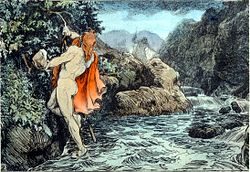
According to Skáldskaparmál they were daughters of the giant Geirröðr. As Thor was wading across Vimur the river "waxed so greatly that it broke high upon his shoulders". He finds out why.
Gyllir
In Norse mythology, Gyllir is a horse listed in both Grímnismál and Gylfaginning among the steeds ridden by the gods each day when they go to make judgements at Yggdrasil. However, in both poems, Gyllir is not assigned to any specific deity.
Gyllir is also found in the thulur as a giant name.
Gymir
In Norse mythology, Gymir was a giant whose daughter, Gerðr, married the god Freyr.
According to the Eddic poems Skírnismál and Hyndluljóð, Gymir and his wife Aurboða are Gerð's and her brother Beli's parents.[1] He is also listed as a distinct cousin to Thjazi. In the Prose Edda, Snorri Sturluson gave this information in Gylfaginning but in a list of kennings in Skáldskaparmál equates Gymir with the god and giant Ægir,[2] citing a verse by Hofgarða-Refr Gestsson where the kenning in question probably simply substitutes one giant-name for another.[3] Gymir is also equated with Ægir in the prose introduction to Lokasenna; however, the Nafnaþulur added later to the Prose Edda list him among the giants. He is credited to live in a great house in Jotunheim surrounded by dogs.[4] Gymir has usually been interpreted as a sea-giant, but Magnus Olsen regarded him as an earth giant in connection with his interpretation of Skírnismál in light of the hieros gamos[5] and he has also been seen as a chthonic deity.[6] Suggestions as to the etymology and meaning of his name include 'earthman', 'the wintry one', 'the protector' and 'the bellower'.[7]
According to John Lindow, one source calls Gerð's father Geysir.
I had to cut this into two parts. So here's this one. I got my information from Wikipedia, which isn't usually a good source but they did a good job here.
G
Ganglot
In Norse mythology, Ganglot ("tardy") was Hel's maidservant in the Norse underworld. She was also the partner of Ganglati, Hel's manservant.
Gangr
In Norse mythology, Gangr or Gang (Old Norse, 'gait') was a giant and a son of Ölvaldi, along with his brothers Þjazi and Iði. According to Skáldskaparmál, Ölvaldi was very rich in gold, and when he died his three sons divided his inheritance among themselves, measuring it out by each in turn taking a mouthful.[1] For this reason the expressions "speech of Þjazi, Gangr or Iði" and "Iði's shining talk" are kennings for gold.
Gangr may also be referring to the effect of berserkergang , where the berserker would go into an utter frenzy and uncontrollable rage.
Geirrod
In Norse mythology, Geirröd was a jötunn and the father of the giantesses Gjálp and Greip.
The story of Geirröd is told in Þórsdrápa. Loki, while flying as a hawk, was captured by Geirröd. Because he hated Thor, Geirröd demanded that Loki bring his enemy to Geirröd's castle without his magic belt and hammer. Loki agreed to lead Thor to the trap. On the way to Geirröd's castle, Loki and Thor stopped at the home of Grid, a giantess. She waited until Loki left the room, then told Thor what was happening and gave him her iron gloves and magical belt and staff. Thor killed Geirröd, followed by all other giants he could find, including Geirrod's daughters, Gjalp and Greip.
Gilling
In Norse mythology, Gilling was the frost giant, father of Suttungr and Baugi and grandfather of Gunnlöð. He and his wife were murdered by Fjalar and Galar. Gilling is also a surname, although not very common.
Gilling was said to be a foolish giant. Two dwarves, Fjalar and Galar, convinced him to row them out to the middle of a lake. They then sank the boat and grabbed on to the flotsam of the wreckage until they made it to shore. Gilling was too foolish to do this and he drowned. His wife was killed when the two dwarves next got on the roof of her house and loudly moaned that Gilling had died. When his wife, screaming in shock, ran outside, they dropped a millstone on her head, killing her as well.[1]
Suttungr vowed to get revenge and tied them to a rock that would soon be covered by the rising tide. The dwarves begged to be let free and promised to give him magic mead as a "thank you" for saving them. Suttung agreed and received the magic mead as a result.
Gjalp and Greip
According to Skáldskaparmál they were daughters of the giant Geirröðr. As Thor was wading across Vimur the river "waxed so greatly that it broke high upon his shoulders". He finds out why.
- "Then Thor saw Gjálp, daughter of Geirröðr, standing in certain ravines, one leg in each , spanning the river, and she was causing the spate. Then Thor snatched up a great stone out of the river and cast it at her, saying these words: 'At its source should a river be stemmed.' Nor did he miss that at which he threw." – Brodeur's translation
- "Then he became aware that the chair moved under him up toward the roof: he thrust Grídr's rod up against the rafters and pushed back hard against the chair. Then there was a great crash, and screaming followed. Under the chair had been Geirrödr's daughters, Gjálp and Greip; and he had broken both their backs." – Brodeur's translation
- "The peace-reluctant slayer of the reindeer of the Lister of the peak [Þórr] was put in a fix there, on the dire, grim hat of the giantess [chair].
- They forced the high heaven of the flame of the brow-moon [Þórr's head] against the rafters of the (rock-)hall [cave], and were crushed against the rocks of the plain (of the rock-hall) [floor]. The hull-controller of the hovering chariot of the thunder-storm [Þórr] broke the ancient keel of the laughter-ship [backbone] of both cave-maidens [giantesses]." – Eysteinn Björnsson's translation
- "[T]hree women, whose bodies were covered with tumours, and who seemed to have lost the strength of their back-bones, filled adjoining seats. Thorkill's companions were very curious; and he, who well knew the reason of the matter, told them that long ago the god Thor had been provoked by the insolence of the giants to drive red-hot irons through the vitals of Geirrod, who strove with him, and that the iron had slid further, torn up the mountain, and battered through its side; while the women had been stricken by the might of his thunderbolts, and had been punished (so he declared) for their attempt on the same deity, by having their bodies broken." – Elton's translation.
- Gridr
- In Norse mythology, Gríðr (Old Norse "greed"[1] or "greed, vehemence, violence, impetuosity"[2]) is a female jötunn who, aware of Loki's plans to have Thor killed at the hands of the giant Geirröd, helped Thor by supplying him with a number of magical gifts which included a pair of iron gloves, and a staff known as Gríðarvölr. These items saved Thor's life. She is also the mother of the god Víðarr by Odin.
Gríðr is referenced in the poem Þórsdrápa and in Snorri Sturluson's Skáldskaparmál. She or a someone of the same name appears as a witch in Illuga saga Gríðarfóstra.
Saxo Grammaticus refers to her as Grytha, the wife of the legendary king Dan I of Denmark, "a matron most highly revered among the Teutons".
Gryla
Grýla is a mythical giantess living in the mountains of Iceland. Most of the stories told about Gryla were to frighten bad children,[1] and her name is mentioned in Snorri Sturluson's thirteenth century Edda.

Grýla was not directly linked to Christmas until the 17th century.[2] By that time she had become the mother of the Yule Lads. Terry Gunnell hypothesizes that the medieval custom of dressing as Grýla may be related to other visiting traditions[3] such as Julebukk or the Yule Goat and that her name may mean "threat" or "threatening".
She has the ability to detect children who are misbehaving year-round. During Christmas time, she comes from the mountains to search nearby towns for her meal.[4] She leaves her cave and hunts for the children. She devours children as her favorite snack. Her favorite dish is a stew of naughty kids for which she has an insatiable appetite. According to legend, there is never a shortage of food for Gryla.[5]
According to folklore Grýla has been married three times. Her third husband Leppalúði is said to be living with her in their cave in the Dimmuborgir lava fields, with the big black Yule Cat and their sons. As Christmas approaches, Grýla sets off looking for naughty boys and girls. The Grýla legend has appeared in many stories, poems, songs and plays in Iceland and sometimes Grýla dies at the end of the story.
Gunnlod -

- In Norse mythology, Gunnlöð (Old Norse "battle-invitation") is a jötunn.
- Gunnlöð is daughter of the giant Suttungr, who was set guard by him in the mountain Hnitbjorg where he housed the mead of poetry.[1] Her grandfather was Gilling.
Gunnlöð was seduced by Odin, who according to the Prose Edda bargained three nights of sex for three sips of the mead and then tricked her, stealing all of it.[2] However, the poem Hávamál of the Poetic Edda tells the story a bit differently: - Gunnlod sat me in the golden seat,
- Poured me precious mead:
- Ill reward she had from me for that,
- For her proud and passionate heart,
- Her brooding foreboding spirit.
- What I won from her I have well used:
- I have waxed in wisdom since I came back,
- bringing to Asgard Odhroerir,
- the sacred draught.
- Hardly would I have come home alive
- From the garth of the grim troll,
- Had Gunnlod not helped me, the good woman,
- Who wrapped her arms around me.[3]
Gyllir
In Norse mythology, Gyllir is a horse listed in both Grímnismál and Gylfaginning among the steeds ridden by the gods each day when they go to make judgements at Yggdrasil. However, in both poems, Gyllir is not assigned to any specific deity.
Gyllir is also found in the thulur as a giant name.
Gymir
In Norse mythology, Gymir was a giant whose daughter, Gerðr, married the god Freyr.
According to the Eddic poems Skírnismál and Hyndluljóð, Gymir and his wife Aurboða are Gerð's and her brother Beli's parents.[1] He is also listed as a distinct cousin to Thjazi. In the Prose Edda, Snorri Sturluson gave this information in Gylfaginning but in a list of kennings in Skáldskaparmál equates Gymir with the god and giant Ægir,[2] citing a verse by Hofgarða-Refr Gestsson where the kenning in question probably simply substitutes one giant-name for another.[3] Gymir is also equated with Ægir in the prose introduction to Lokasenna; however, the Nafnaþulur added later to the Prose Edda list him among the giants. He is credited to live in a great house in Jotunheim surrounded by dogs.[4] Gymir has usually been interpreted as a sea-giant, but Magnus Olsen regarded him as an earth giant in connection with his interpretation of Skírnismál in light of the hieros gamos[5] and he has also been seen as a chthonic deity.[6] Suggestions as to the etymology and meaning of his name include 'earthman', 'the wintry one', 'the protector' and 'the bellower'.[7]
According to John Lindow, one source calls Gerð's father Geysir.
Subscribe to:
Comments (Atom)