I had to cut this into two parts. So here's this one. I got my information from Wikipedia, which isn't usually a good source but they did a good job here.
G
Ganglot
In Norse mythology, Ganglot ("tardy") was Hel's maidservant in the Norse underworld. She was also the partner of Ganglati, Hel's manservant.
Gangr
In Norse mythology, Gangr or Gang (Old Norse, 'gait') was a giant and a son of Ölvaldi, along with his brothers Þjazi and Iði. According to Skáldskaparmál, Ölvaldi was very rich in gold, and when he died his three sons divided his inheritance among themselves, measuring it out by each in turn taking a mouthful.[1] For this reason the expressions "speech of Þjazi, Gangr or Iði" and "Iði's shining talk" are kennings for gold.
Gangr may also be referring to the effect of berserkergang , where the berserker would go into an utter frenzy and uncontrollable rage.
Geirrod
In Norse mythology, Geirröd was a jötunn and the father of the giantesses Gjálp and Greip.
The story of Geirröd is told in Þórsdrápa. Loki, while flying as a hawk, was captured by Geirröd. Because he hated Thor, Geirröd demanded that Loki bring his enemy to Geirröd's castle without his magic belt and hammer. Loki agreed to lead Thor to the trap. On the way to Geirröd's castle, Loki and Thor stopped at the home of Grid, a giantess. She waited until Loki left the room, then told Thor what was happening and gave him her iron gloves and magical belt and staff. Thor killed Geirröd, followed by all other giants he could find, including Geirrod's daughters, Gjalp and Greip.
Gilling
In Norse mythology, Gilling was the frost giant, father of Suttungr and Baugi and grandfather of Gunnlöð. He and his wife were murdered by Fjalar and Galar. Gilling is also a surname, although not very common.
Gilling was said to be a foolish giant. Two dwarves, Fjalar and Galar, convinced him to row them out to the middle of a lake. They then sank the boat and grabbed on to the flotsam of the wreckage until they made it to shore. Gilling was too foolish to do this and he drowned. His wife was killed when the two dwarves next got on the roof of her house and loudly moaned that Gilling had died. When his wife, screaming in shock, ran outside, they dropped a millstone on her head, killing her as well.[1]
Suttungr vowed to get revenge and tied them to a rock that would soon be covered by the rising tide. The dwarves begged to be let free and promised to give him magic mead as a "thank you" for saving them. Suttung agreed and received the magic mead as a result.
Gjalp and Greip
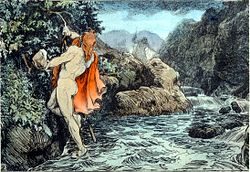
According to Skáldskaparmál they were daughters of the giant Geirröðr. As Thor was wading across Vimur the river "waxed so greatly that it broke high upon his shoulders". He finds out why.
- "Then Thor saw Gjálp, daughter of Geirröðr, standing in certain ravines, one leg in each , spanning the river, and she was causing the spate. Then Thor snatched up a great stone out of the river and cast it at her, saying these words: 'At its source should a river be stemmed.' Nor did he miss that at which he threw." – Brodeur's translation
- "Then he became aware that the chair moved under him up toward the roof: he thrust Grídr's rod up against the rafters and pushed back hard against the chair. Then there was a great crash, and screaming followed. Under the chair had been Geirrödr's daughters, Gjálp and Greip; and he had broken both their backs." – Brodeur's translation
- "The peace-reluctant slayer of the reindeer of the Lister of the peak [Þórr] was put in a fix there, on the dire, grim hat of the giantess [chair].
- They forced the high heaven of the flame of the brow-moon [Þórr's head] against the rafters of the (rock-)hall [cave], and were crushed against the rocks of the plain (of the rock-hall) [floor]. The hull-controller of the hovering chariot of the thunder-storm [Þórr] broke the ancient keel of the laughter-ship [backbone] of both cave-maidens [giantesses]." – Eysteinn Björnsson's translation
- "[T]hree women, whose bodies were covered with tumours, and who seemed to have lost the strength of their back-bones, filled adjoining seats. Thorkill's companions were very curious; and he, who well knew the reason of the matter, told them that long ago the god Thor had been provoked by the insolence of the giants to drive red-hot irons through the vitals of Geirrod, who strove with him, and that the iron had slid further, torn up the mountain, and battered through its side; while the women had been stricken by the might of his thunderbolts, and had been punished (so he declared) for their attempt on the same deity, by having their bodies broken." – Elton's translation.
- Gridr
- In Norse mythology, Gríðr (Old Norse "greed"[1] or "greed, vehemence, violence, impetuosity"[2]) is a female jötunn who, aware of Loki's plans to have Thor killed at the hands of the giant Geirröd, helped Thor by supplying him with a number of magical gifts which included a pair of iron gloves, and a staff known as Gríðarvölr. These items saved Thor's life. She is also the mother of the god Víðarr by Odin.
Gríðr is referenced in the poem Þórsdrápa and in Snorri Sturluson's Skáldskaparmál. She or a someone of the same name appears as a witch in Illuga saga Gríðarfóstra.
Saxo Grammaticus refers to her as Grytha, the wife of the legendary king Dan I of Denmark, "a matron most highly revered among the Teutons".
Gryla
Grýla is a mythical giantess living in the mountains of Iceland. Most of the stories told about Gryla were to frighten bad children,[1] and her name is mentioned in Snorri Sturluson's thirteenth century Edda.

Grýla was not directly linked to Christmas until the 17th century.[2] By that time she had become the mother of the Yule Lads. Terry Gunnell hypothesizes that the medieval custom of dressing as Grýla may be related to other visiting traditions[3] such as Julebukk or the Yule Goat and that her name may mean "threat" or "threatening".
She has the ability to detect children who are misbehaving year-round. During Christmas time, she comes from the mountains to search nearby towns for her meal.[4] She leaves her cave and hunts for the children. She devours children as her favorite snack. Her favorite dish is a stew of naughty kids for which she has an insatiable appetite. According to legend, there is never a shortage of food for Gryla.[5]
According to folklore Grýla has been married three times. Her third husband Leppalúði is said to be living with her in their cave in the Dimmuborgir lava fields, with the big black Yule Cat and their sons. As Christmas approaches, Grýla sets off looking for naughty boys and girls. The Grýla legend has appeared in many stories, poems, songs and plays in Iceland and sometimes Grýla dies at the end of the story.
Gunnlod -

- In Norse mythology, Gunnlöð (Old Norse "battle-invitation") is a jötunn.
- Gunnlöð is daughter of the giant Suttungr, who was set guard by him in the mountain Hnitbjorg where he housed the mead of poetry.[1] Her grandfather was Gilling.
Gunnlöð was seduced by Odin, who according to the Prose Edda bargained three nights of sex for three sips of the mead and then tricked her, stealing all of it.[2] However, the poem Hávamál of the Poetic Edda tells the story a bit differently: - Gunnlod sat me in the golden seat,
- Poured me precious mead:
- Ill reward she had from me for that,
- For her proud and passionate heart,
- Her brooding foreboding spirit.
- What I won from her I have well used:
- I have waxed in wisdom since I came back,
- bringing to Asgard Odhroerir,
- the sacred draught.
- Hardly would I have come home alive
- From the garth of the grim troll,
- Had Gunnlod not helped me, the good woman,
- Who wrapped her arms around me.[3]
Gyllir
In Norse mythology, Gyllir is a horse listed in both Grímnismál and Gylfaginning among the steeds ridden by the gods each day when they go to make judgements at Yggdrasil. However, in both poems, Gyllir is not assigned to any specific deity.
Gyllir is also found in the thulur as a giant name.
Gymir
In Norse mythology, Gymir was a giant whose daughter, Gerðr, married the god Freyr.
According to the Eddic poems Skírnismál and Hyndluljóð, Gymir and his wife Aurboða are Gerð's and her brother Beli's parents.[1] He is also listed as a distinct cousin to Thjazi. In the Prose Edda, Snorri Sturluson gave this information in Gylfaginning but in a list of kennings in Skáldskaparmál equates Gymir with the god and giant Ægir,[2] citing a verse by Hofgarða-Refr Gestsson where the kenning in question probably simply substitutes one giant-name for another.[3] Gymir is also equated with Ægir in the prose introduction to Lokasenna; however, the Nafnaþulur added later to the Prose Edda list him among the giants. He is credited to live in a great house in Jotunheim surrounded by dogs.[4] Gymir has usually been interpreted as a sea-giant, but Magnus Olsen regarded him as an earth giant in connection with his interpretation of Skírnismál in light of the hieros gamos[5] and he has also been seen as a chthonic deity.[6] Suggestions as to the etymology and meaning of his name include 'earthman', 'the wintry one', 'the protector' and 'the bellower'.[7]
According to John Lindow, one source calls Gerð's father Geysir.

No comments:
Post a Comment